
Table of Contents
This twelfth installment delves into the heart of The Nakba, contrasting the heroic steadfastness of the local Palestinian Resistance against the disastrous mismanagement and calculated failure of the Arab Salvation Army. It exposes how the Arab League’s intervention, intended to contain public anger, ultimately handcuffed the indigenous defense, leading to the fall of cities and the loss of the land despite the Palestinians holding the majority of the territory before the official armies arrived.
In the Name of ALLAH, the Most Gracious, the Most Merciful. All Praise is due to ALLAH and Peace and Blessings be upon the Messenger of ALLAH, His family, His companions, and those who align with Him.
Welcome, beloved brothers, to a new article in the “The Story of Palestine“. This series briefly summarizes the essence of Palestine’s history, from the inception of the idea of a Jewish return to the land, up until the moment the Flood erupted in October 2023. The aim is to understand the roots of this story: Why does it remain a burning, inflamed issue? How did Herzl succeed where his ancestors failed for 3,000 years? And what is the future of this story as mentioned in the Quran and Sunnah, and as indicated by current events?
Once again, for those who wish to verify the information presented in these articles, they are extracted from the book “Summary of the Story of Palestine“1. A download link will be provided for those wishing to refer to the details.
The narrative has now reached the moment of the declaration of Israel—meaning, we have reached the Nakba. Before delving into the discourse and getting lost in details, it is essential to place the reader of this article in a summary of what happened during the Nakba so that it is clear.
The Palestinians entered the 1948 war practically holding 94% of the land, and they constituted 69% of the population. Meaning, despite all waves of Jewish immigration and all attempts to purchase land, the final summary is that the Palestinians entered the war with 94% of the land and 69% of the population. They then exited after the Nakba with Israel having seized 78% of the land and displaced 800,000 of the inhabitants. This is the summary; now, let us examine the story.
The Three Levels of Defense Against the Zionist Conquest
First, despite all the services Britain provided to the Zionists—and naturally, Britain was the superpower—and despite thirty years of occupation, the Zionist seizure of the country was ultimately not a picnic, nor was it an easy matter. Rather, it met violent resistance from the Palestinian side. These Palestinians, despite the oppressive conditions, miserable circumstances, difficult situations, scarce resources, and international and Arab complicity—despite all this, they resisted. Ahmed Al-Shukeiri, the Palestinian leader, had a phrase in his memoirs:
Had scientific mathematical facts been the decider of fate, the Jewish homeland should have been established in a few short years, not after thirty years
This statement indicates the magnitude of the brave Palestinian resistance exerted by the people.
To simplify the history of this era—an era packed and teeming with details—the discussion will focus on three levels of resistance to the establishment of Israel:
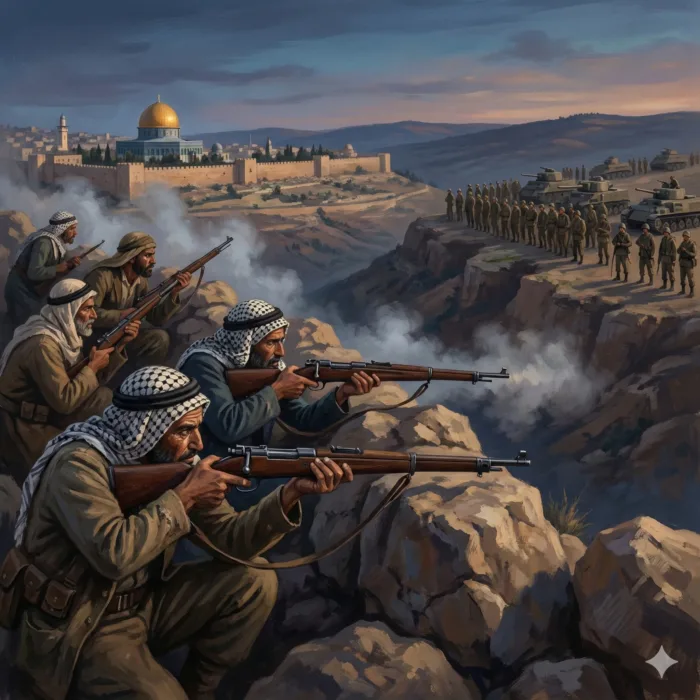
- The First Level: The level of indigenous Palestinian resistance, most notably the Holy Jihad Army (Jaysh al-Jihad al-Muqaddas) led by Abd al-Qadir al-Husseini.
- The Second Level: The level of the “Salvation Army” (Jaysh al-Inqadh), which was established by the Arab League to organize volunteers for Jihad in Palestine.
- The Third Level: The level of the official Arab armies that entered Palestine after the departure of the British Mandate.
Naturally, the term “resistance” is used now, but details will follow. It must be stated first that these three levels (the Palestinian Holy Jihad Army, the volunteer Salvation Army, and the official Arab armies) did not possess the weapons, ammunition, training, military experience, funds, supply lines, or even the political backing that the Zionist gangs possessed. Even the official Arab armies were meager in number, poorly equipped, and lacked previous military experience because they were originally subject to foreign occupation regimes.
It must also be noted that the people of Palestine were deprived of defending themselves and their lands. The Palestinians preferred to shoulder the burden of this resistance themselves because they knew the land best and knew the enemy best. They hoped that the Arab states would only secure funds and weapons for them, believing they were capable of the task. They wanted this, and they had a political viewpoint in doing so; the non-entry of Arab armies would strip Zionist propaganda of the narrative they relied upon—the idea that brought them more money and men.
The Zionists portrayed themselves as a small, emerging state seeking independence while being attacked by large surrounding Arab nations, states larger in size, number, and equipment. Naturally, all of this was untrue; as mentioned, the Zionist gangs were superior in number, equipment, training, military experience, and backing compared to the combined Arab armies.
The summary here is that the Palestinians wanted the Arab states to remain outside and not send their official armies, but only to supply the Palestinian resistance with money and arms, as they were capable of holding back the Zionists. However, the bitter truth is that the tycoons of the Arab League and the official regimes insisted on not leaving this matter to the people of Palestine. Instead, they rushed in themselves, increasing the situation’s worsening and confusion. Anyone looking at history finds that Arab policy and Arab armies during this period played the primary role in enabling Israel and entrenching its existence. Historically, this is what happened.
The Holy Jihad Army: The Heroism of Abd al-Qadir al-Husseini
Before entering into details, one must not forget that this Palestinian society was also deprived—just as it was deprived of self-defense—of the presence of political leadership on its land. The Egyptian authority prevented Haj Amin al-Husseini, the only recognized political leader of the Palestinians, from entering Palestine at that time.
With these observations established, let us enter the first level of resistance mentioned: the self-reliant Palestinian resistance, prominently featured in the “Holy Jihad Army” under the leadership of Abd al-Qadir al-Husseini. Abd al-Qadir al-Husseini attempted to organize popular efforts to form an armed resistance, and this attempt was, in reality, the most successful effort in the history of Palestinian resistance since the Great Palestinian Revolt. Abd al-Qadir was, of course, a prominent name present in that revolution (the 1936 revolt); he was wounded in it, arrested, managed to escape, and moved between Arab and European countries.
In the summer of 1946, Abd al-Qadir al-Husseini met in Cairo with his cousin, Mufti Amin al-Husseini, who was mentioned as the political leader of the Palestinians. Amin al-Husseini, as previously noted, had fled Palestine during the Great Arab Revolt, moved between several countries, met with Axis powers and Germany, and tried to extract a promise from them to liberate his country and not empower the Zionists.
However, the defeat of these nations in World War II destroyed his dreams. He remained a fugitive hunted by the Jews until he ended up in Cairo. In Cairo, the Arab Higher Committee was formed or convened, and an agreement was reached to form the armed resistance that bore this name: “The Holy Jihad”, with leadership given to Abd al-Qadir al-Husseini.
Abd al-Qadir al-Husseini toured the villages and, with his good reputation and relationships, was able to recruit a large number of young men, whether for military operations, protecting villages from attacks, or managing them in agreement with village notables. The Holy Jihad organization was divided into several units:
- A unit to enforce the boycott (boycotting dealings with Jews or buying land/products); it monitored the boycott and fought those dealing with Jews, warning them, and if they did not respond, burning their warehouses, homes, and goods.
- Another unit to resist land sales; it warned the brokers working to transfer land from Arabs to Jews, and if they did not respond, assassinated them.
- Other units for dividing military work according to regions.
- Units for auxiliary works, or what is now called “logistics.”
- Units interested in security and intelligence work to gather information.
The army, or the command center for this Holy Jihad Army, was located in the city of Jerusalem (Bayt al-Maqdis) because this city contained the most important Zionist colonies. Naturally, Jerusalem is the heart of the conflict in Palestine, and one can say that Jerusalem is the scale of the real battle that would determine the fate of this Israeli state. Therefore, the most important battles of the Holy Jihad Army took place in and around Jerusalem.
This army was distinguished by matters lacking in the Salvation Army (the volunteer army which will be discussed) and also lacking in the official Arab armies. The most important distinction of the Holy Jihad Army was the presence of a sincere, competent leader like Abd al-Qadir al-Husseini, and that its soldiers were people of the land. The locals knew the land best, knew the population best, knew the nature of the areas best, and also knew the enemy best.
This Holy Jihad Army fought a number of battles and displayed heroism and bravery far exceeding its capabilities. It won decisive battles against the Zionists, even when enemy forces outnumbered them in men and equipment. However, in the end, this army—which was less than an army, truthfully closer to an organization—could not obstruct the march of the Zionist state for a simple reason: it fought until it ran out of ammunition. It ended. The conspiracy against this army, or this organization (the Holy Jihad organization), was predominantly Arab.
The Arab League, from the beginning, worked to hinder and obstruct the jihad of Abd al-Qadir al-Husseini. First, they tried to control him and make him subordinate to their authority and orders, but he broke away from them and formed this organization. However, he needed money and ammunition; ultimately, he was fighting battles. Therefore, he was always forced to communicate with the Arab League and forced to communicate with the Salvation Army (the volunteer army belonging to the Arab League).
Consequently, mediations took place between him and the Arab League, and the League imposed conditions on him. Among these conditions, for example: he must not collect money from the villages (meaning, no seeking self-funding) and remain linked only to Arab League funding, and his work must not exceed the Jerusalem area (meaning, not fighting in other places to defend cities that would fall). Naturally, there were other matters; they tried to control him, and he tried to maneuver around them.
The Salvation Army, which was subordinate to the Arab League, stood in opposition to Abd al-Qadir al-Husseini; it was not cooperative with him and did not respond to his requests for supplies, weapons, and ammunition. The final visit of Abd al-Qadir al-Husseini to the command of the Salvation Army—which was in Damascus—was to request a supply of ammunition and weapons. They did not respond to him; rather, they treated him with rudeness. These details can be read in books such as In the Midst of the Palestinian Struggle by Bahjat Abu Gharbieh (one of the leaders in the Holy Jihad organization) and other sources.
While Abd al-Qadir al-Husseini was in Damascus, he heard the news of the fall of the village of “Al-Qastal”. This village was extremely important because it was located on the road between Jaffa (the port from which supplies came) and Jerusalem (the most important Zionist colonies and blocs). Whoever controlled this village controlled the road. Abd al-Qadir returned immediately to liberate this village, this important site. Indeed, he was able to liberate it, but he fell as a martyr in this battle. His martyrdom was the most significant blow to strike the Holy Jihad Army.
The martyr Abd al-Qadir al-Husseini left his final message two days before his martyrdom. Its text is as follows:
To the Secretary-General of the Arab League, I hold you responsible after you left my soldiers at the peak of their victories without aid or weapons
One day after the martyrdom of Abd al-Qadir al-Husseini—his funeral was the following day—the Deir Yassin massacre took place on April 9, 1948. This massacre was the opening chapter of the displacement. This is the summary of the first level, which is the level of Palestinian resistance by the people themselves.
The Arab Salvation Army: A Tool for Containment, Not Liberation
Regarding the second level, mentioned as the “Salvation Army” (Jaysh al-Inqadh) or the “Volunteer Army”. Naturally, there was an overwhelming Arab Islamic sentiment for Jihad in Palestine. This wave was too high for the Arab regimes at that time to stand against. Therefore, these regimes worked to absorb this popular wave by announcing the formation of the “Salvation Army” (the Volunteer Army), stating that whoever wanted to join the liberation of Palestine could join this army. Here began the chapters of a new conspiracy against the Arab peoples and the people of Palestine through the formation of this army.
How was the conspiracy orchestrated? The first chapter of this conspiracy was that the Arab regimes banned volunteering for any body unless it was under the command of this army. They wanted to co-opt the popular effort and restrict it to this army alone. They also banned battalions from joining under the command of this army as units; meaning, whoever wanted to join had to join individually.
Consequently, all other organizational bodies and popular activities lost the ability to utilize their own structures, movements, and cohesion. Those who did not accept this and broke away were denied weapons and ammunition. When weapons and ammunition were withheld from these bodies that did not join (as individuals) under the Salvation Army, it hindered their ability to absorb volunteers because there were no weapons; there was a scarcity of arms.
This army (the Salvation Army) took its headquarters in Damascus. Three men stood out in its leadership. Naturally, they had experience and history, but in this war—unfortunately—they appeared in a miserable, dilapidated, and weak manner. This appearance contradicted their history in a crude way. Therefore, gaps remain to this day in interpreting their behavior; historians still have analyses and interpretations, but the gaps remain: How did these men turn into this miserable, wretched state? You will find that these commanders fought the battle with catastrophic performance, behaving as a regular army rather than a volunteer army, and their work seemed like part of the English conspiracy against Palestine.
These three commanders were: Ismail Safwat, Taha al-Hashimi, and Fawzi al-Qawuqji.
- Ismail Safwat: An Iraqi military expert who rose through the military ranks. His biography is that of a soldier, but the highlight of his history is that he participated in the Iraqi Revolution of 1920.
- Taha al-Hashimi: Also an Iraqi military expert with very famous writings on war, military history, and urban geography. He also had a history of fighting wars. He rose through the ranks to the point of being the Iraqi Minister of Defense in 1938 and Prime Minister in 1941. By 1948, he was about sixty years old, meaning he was a man lacking neither experience nor knowledge nor practice.
- Fawzi al-Qawuqji: Also nearing sixty in 1948. He was an expert in guerrilla warfare, a veteran fighter who fought against the English in Basra, fought in the Ottoman ranks in World War I, fought the French in the Levant (Sham), was the leader of the revolution in Hama against the French, and was one of the leaders of the Syrian Revolution in the 1920s. Fawzi al-Qawuqji’s life resembled a permanent revolution and continuous struggle. He was a man of whom it could be said: “Whenever he heard a call to war, he flew to it“. His name was mentioned previously as participating as a volunteer in the Great Palestinian Resistance of 1936, and he also participated in the attempt and revolution of Rashid Ali al-Gaylani in 1941. He moved through the paths of Jihad until he returned once again to the Levant in 1948.
Of these three commanders, the first two (Ismail Safwat and Taha al-Hashimi) were not guerrilla warfare men; they did not enter Palestine and did not know Palestine. The problem was that the relationship between these three was clouded by fear and suspicion. If the commanders of battle harbor fear and suspicion toward one another, what will happen in the battles? Furthermore, the most dangerous and severe dispute was between them collectively and the leader of Palestine, Haj Amin al-Husseini.
Mufti Amin al-Husseini was an enemy of the Hashemite regime in Jordan and the Hashemite regime in Iraq. His enmity with the Jordanian regime is understandable; AbduLLAH was an agent for the English, while Amin al-Husseini was an enemy of the English, and both competed for the land (the West Bank or Palestine). As for the enmity of the Iraqi Hashemite regime toward Amin al-Husseini, it was because Amin contributed to the failed revolutionary attempt against the Iraqi Hashemite regime (Rashid Ali al-Gaylani’s attempt in 1941) which sought to get rid of British influence. Britain then intervened, crushed the revolution, and stabilized the Hashemite monarchy.
Both men (Taha al-Hashimi and Ismail Safwat) were men of the Iraqi regime. In truth, the leadership was formed in this manner by the Arab League specifically to be hostile, primarily to exclude Mufti Amin al-Husseini and his men. This was originally the policy of the Arab League: preventing Palestinians from holding the file of their own cause.
The Mufti also—as mentioned—believed that the politically and militarily correct path was to rely on the people of Palestine, arming and training them, without the need for regular military blocs to enter. Even assuming a need existed for military blocs and volunteer armies, these volunteers should have entered under the Mufti’s command and under the field command of Abd al-Qadir al-Husseini, because the people of Palestine knew the land best and were in greater need of weapons, money, and training than of men (they needed arms and funds more than they needed men).
Importantly, the dispute between the Salvation Army commanders on one side and the Mufti on the other led to extremely dire consequences, at a time of severe criticality that could not tolerate the slightest disagreement.
The Nakba: Catastrophic Errors and the Loss of the Land
This Salvation Army opened the door to volunteers, and volunteers flocked to it (Fawzi al-Qawuqji’s house was described as never stopping receiving volunteers even for an hour of the day). However, the weapons sent by the Arab League were not sufficient for these volunteers. They sent a few hundred rifles, while the volunteers were tens of thousands who could have been mobilized to fight the battle.
The army was paralyzed on one hand by the capabilities sent by the Arab regimes, and also paralyzed by timing and the authorities granted to it. All of this was chaos. When reading the memoirs of al-Qawuqji and Taha al-Hashimi, one finds chaos; he does not know his authorities, does not know when to move, does not know when funds and equipment will arrive, and has no independent authority. Therefore, it is common in their writings that they place the responsibility on these regimes, their policies, their delays, and their slowness.
The goal itself was unclear: Was the goal to support the people of Palestine? Or to fight a battle with the Zionists? Or to keep the situation hot and moving until the Arab armies arrived? This goal itself was unclear, and military plans are built upon goals. This was from the political side.
As for the operation itself, the Salvation Army committed a number of errors with these capabilities and authorities. Regarding these errors, eyewitnesses and historians differ: Were these errors intentional? Were they conspiracy and treason? Or were some intentional and others conspiracy and treason? Some will be selected here without entering into deep analysis.
- Closing Recruitment: The major problem committed by the Salvation Army was accepting a small number of volunteers and then closing the door, saying: “That’s it, the number of volunteers is far greater than required. If Palestine needs more, we will open the door again”. They closed the door on volunteers. Recall that it was forbidden for any body or any volunteers to act unless under the command of this army. Reflect on this!
- Selecting Unsuitable Fighters: They intentionally selected fighters from useless categories—criminals and the unemployed. Sheikh Mustafa al-Sibai has a book titled Our Jihad in Palestine; read it, as it is very important regarding this. They selected fighters from characters deemed unfit to remain in their own countries. when these men joined the Salvation Army and entered Palestine, incidents of looting and plundering Palestinians, assaults on honor, and assaults on shops appeared within the Salvation Army. Sometimes internal armed clashes occurred between these volunteers. Imagine this happening in the “Salvation” Army! Even worse, some Zionist spies and Arab agents working for the Jews managed to join the ranks of the Salvation Army.
- Inappropriate Training: They trained volunteers as if training a regular army in a stable period. You do not train a volunteer to enter a battle this way; it was slow and monotonous while events were accelerating.
- Random Tactics: They pushed fighters without a plan, organization, or arrangement in most battles. The movement of attack and withdrawal was random; random attacks, fighting until ammunition ran out, then withdrawing randomly. Consequently, this did not lead to victory but often to defeat, as disorganized withdrawal leads to defeat. Some even sat in cafes, abandoning the outposts and battlefronts.
- Passive Location: The work of this Salvation Army, though a volunteer army, was limited to the areas allocated to Arabs by the partition resolution. Meaning, its work was in areas not exposed to Zionist threat. Fawzi al-Qawuqji, for example, resided in Nablus (he was the only field commander of the three who entered Palestine). While in Nablus, he did not move to relieve the cities falling before him—cities the partition resolution assigned to the Jews. Jaffa and Haifa fell before him, and he did not extend a hand. Even a town like Deir Yassin, though close to his location, saw no movement from him.
- Abandoning Abd al-Qadir: They refused effective cooperation with Abd al-Qadir al-Husseini and refused to supply him with weapons needed in decisive moments, as discussed regarding the Battle of Al-Qastal.
- Withholding Support: They refused to cooperate with other volunteer factions and prevented supplying them with ammunition. These factions were sometimes defending Jerusalem. Taha al-Hashimi refused to support the Muslim Brotherhood volunteer forces in Jerusalem and refused to supply them with the money necessary to buy weapons from British Army surplus (the British Army was selling weapons, but the volunteers had no money to buy what could be bought).
- Surrendering Cities: There was easy and frequent negligence regarding very important cities (Jaffa, Haifa, and even Jerusalem). Taha al-Hashimi justified why Jerusalem was abandoned by saying, “Jerusalem is not a strategic city, and retrieving it is easy and possible at any time“. Naturally, this was untrue; the fall of Jerusalem had a dangerous strategic and political impact, not to mention its massive morale impact on Arabs and Jews (the Holy City). Amin al-Husseini mentioned this in his memoirs, noting it was as if Taha al-Hashimi did not know Jerusalem, despite being an expert in urban geography as his writings indicated.
- Adhering to Political Orders: The Salvation Army adhered to the general policy of the Arab regimes; orders to withdraw or advance came from political capitals, and the army obeyed them rather than moving according to battlefield necessities. It acted like a regular army, not a volunteer army (volunteers usually do not adhere to politics or UN resolutions). There was an ease in issuing withdrawal orders and executing them without plans, causing many cities to fall easily. Sometimes the Jews were astonished by the speed of this collapse, as stated by the historian of the Nakba, Aref al-Aref, in his book The Nakba: The Catastrophe of Jerusalem and the Lost Paradise.
This army also committed the crime of disarming the locals in Palestine; it would take weapons from the Palestinians and then withdraw before the Zionist attack, leaving the village defenseless. This, for example, is what Fawzi al-Qawuqji did in the villages of Upper Galilee. Another error was accepting a truce in precious moments. The Jews quickly exploited this truce to turn the balance of the battle. There is a famous battle (the most important one Fawzi al-Qawuqji fought) called the battle of “Mishmar HaEmek”.
Above all this, these volunteers found no support or backing from political capitals in critical moments. Even after the entry of official Arab armies, the Arab official did not care if the forces pleaded for help. The moment forces asked for help, he would request them to withdraw, telling them: “Your lives are more precious and important”, even if this withdrawal caused massive massacres of refugees or locals, and even if this was in Jerusalem. Truthfully, there are bitter details about this in Sheikh Mustafa al-Sibai’s book Our Jihad in Palestine; as the leader of the Muslim Brotherhood volunteers in Syria, he narrated very dangerous things from his conversations with Taha al-Hashimi and Ismail Safwat.
Consequently, one can imagine the expected result of all this. If a battle occurs between Zionist gangs and these forces, what happens? The result was that these untrained divisions were defeated by trained, organized, and supported Jewish gangs—supported sometimes by English forces and English policy. There is no doubt that the leadership of the Salvation Army bears a large share of the loss of Palestine and the loss of Jerusalem.
It was mentioned that they were extremely arrogant and rude to Abd al-Qadir al-Husseini in his most critical times. He himself stated to Ismail Safwat and Taha al-Hashimi: “You are traitors, you are criminals, and history will record that you lost Palestine”. When he left them, he knew his fate would be nothing but martyrdom because he no longer held the means to fight.
In summary, regarding the experience of those who dealt with the Salvation body—as mentioned by Sheikh Mustafa al-Sibai—he used to say: This Salvation Army was created to anesthetize the raging Arab sentiment, and it was not actually intended for fighting. It did not fight a single serious battle in Palestine, its leaders did not know the reality of the situation, and its real mission was to destroy the Holy Jihad organization led by Abd al-Qadir al-Husseini.
Bahjat Abu Gharbieh—previously mentioned as a great fighter, nicknamed the Sheikh of Fighters, who died at about ninety-six years old in 2012 (born 1916)—said in his book and memoirs In the Midst of the National Palestinian Struggle that this army was but a means to block weapons, aid, and donations from the people of Palestine. It was created to be a stumbling block; anyone wanting to give money or weapons brought them to this army controlled and dominated by the Arab League.
He says: It was a means to withhold weapons, aid, and donations from the people of Palestine, and a means to absorb Arab volunteer youth and drain their energy to implement the partition resolution. Truthfully, it was an Arab political combat tool designed to prevent Palestinians from defending themselves and their land.
Imagine this surprise with all that has been mentioned: The surprising fact is that the people of Palestine, along with the volunteers (naturally, there were volunteers who broke away from the Salvation Army’s decisions, and other volunteers), managed to hold onto 82% of the land of Palestine before the official Arab armies entered. Meaning, they lost between 10.5% to 12% of the land only, before the official Arab armies entered.
When the Arab armies enter, how much will they lose? And how much will Palestine lose? This is what will be seen, ALLAH willing, in the next episode.
We ask ALLAH, the Blessed and Exalted, to teach us what benefits us, to benefit us with what HE has taught us, and to increase us in knowledge. Peace, mercy, and blessings of ALLAH be upon you.
Sources:
Mohamed Elhamy. قصة فلسطين | 12. مهزلة جيش المتطوعين العرب.. جيش لتسهيل تسليم فلسطين!. Telegram Video.
