Table of Contents
This eleventh installment unravels the harrowing road to the Nakba, exposing the calculated betrayal of the British mandate and the political paralysis of the Arab world. It dissects the fragility of the Syrian regime, the rise of US influence post-World War II, and the unjust mechanics of the UN Partition Plan, culminating in the tragic fall of Palestinian cities and the declaration of the State of Israel amidst international conspiracy and Arab inaction.
In the Name of ALLAH, the Most Gracious, the Most Merciful. All Praise is due to ALLAH, and Peace and Blessings be upon the Messenger of ALLAH, His family, His companions, and those who follow Him.
Welcome, beloved brothers, to a new article in “The Story of Palestine“. This series briefly summarizes the essence of Palestine’s history, from the inception of the idea of a Jewish return to the land, up until the outbreak of the Flood in October 2023. The aim is to understand this story: Why does it remain burning and inflamed? Why was Herzl able to succeed where his ancestors failed for three thousand years? And what is the future of this cause as mentioned in the Quran and Sunnah?
For those who wish to verify details or expand their knowledge, these articles are extracted from the book “Summary of the Story of Palestine“1. One can refer back to it to follow the source of every piece of information accurately.
The previous article discussed the conditions and situations that led to The Nakba, focusing on the states surrounding Palestine, as understanding the status of these nations is essential to grasping how the catastrophe occurred. The discussion covered Egypt and Jordan, and now it continues with Syria.
The Political Landscape of Syria and the Divide in the Arab World
After World War I, Britain placed Faisal bin Sharif Hussein as the ruler of Syria. However, disagreements with France regarding the Sykes-Picot Agreement led the French to invade Syria and expel Faisal. Consequently, the British took him and installed him as king of Iraq when they occupied it. Thus, Syria fell under French occupation from 1920 until it gained independence in 1946. It can be said that during the period from 1936 to 1946, the Syrian government enjoyed a measure of independence—admittedly formal and nominal, yet it allowed for a small degree of freedom of movement, similar to the Egyptian government after 1922 following its arrangement with the British mandate.
When World War II arrived, the sun began to set on the French occupation, which represented the “Old Colonialism”, largely due to pressure from the Americans who represented the “New Colonialism”. At that time, a rivalry erupted between the ruling regimes in Syria and Jordan. The king of Jordan—recalling what was mentioned in the previous article—aspired to annex Syria under his rule. He was still chasing the dream of his father, Sharif Hussein, or perhaps it was the dream that was chasing him. He desired a “Greater Arab State” encompassing the Levant (Sham), Iraq, and the Arabian Peninsula; thus, he attempted to extend his influence into Syria.
In contrast, the regime that had gained independence in Syria, even if formal and incomplete, was a system that detested monarchy and sought a civil, democratic, and parliamentary republic. The Syrian regime viewed Jordan as originally Syrian land; they believed it was a territory severed from the Levant. Since Syria is the largest state in the Levant, they argued it was unnatural for Jordan to be a separate state at all, considering it a dependency of Syria. Consequently, AbduLLAH in Jordan wanted Syria to expand his rule, while the government in Syria believed the state of Jordan was a limb torn from Syria that must be returned.
Even if the Syrian government were to consider a monarchy and abandon the republic, their goal could never be AbduLLAH. AbduLLAH was known for his treachery; even if they accepted a king, they would not accept a king famous for betrayal. When the situation in Palestine began to deteriorate, events were moving toward the intervention of Arab armies. AbduLLAH, the king of Jordan, feared that the Saudi and Syrian forces might actually be advancing to occupy Jordan itself. Therefore, he hastened to request that Iraq—ruled by Hashemites, his cousins and the sons of his brother Faisal—send their forces to him as well, to avoid this perceived conspiracy.
It can be said that the Arab countries at that time were akin to two camps: a camp containing Egypt, Syria, and Saudi Arabia, and a camp containing Iraq and Jordan. Naturally, the hand of the British mandate was above them all. All these countries were effectively under British rule, except for Syria, which was under French influence. It could be argued that the regime in Syria at the time was the “least bad” among these systems.
However, this regime also feared British occupation. It was not a regime capable of rushing to save Palestine or antagonizing England to the extent of declaring open hostility, for Britain was, after all, a superpower. Ultimately, political red lines were memorized and respected by the regime in Syria.
This was the state of the “Confrontation States”—Egypt, Jordan, and Syria—the important nations surrounding Palestine. It is evident that these Confrontation States were not effective in supporting the Palestinian presence, nor were they effective in breaking the Zionist presence. They were, in origin, states still under occupation.
In fact, the opposite is true: these states were effective in supporting the Zionist presence—specifically Egypt and Jordan—and effective in breaking the resolve of the Palestinians. As mentioned previously, Saudi Arabia, Yemen, Iraq, and Jordan pressured the Arab Higher Committee in Palestine to end the 1936 strike. Ultimately, it can be said that this Zionist state could not have been established or stabilized had the regimes ruling the Arab world at that time not been in such a condition. It will become clear shortly how these nations interacted to effectively lie in wait for the Zionist state during the war of 1948, leading to The Nakba.
The Weakness of the Islamic World and the Rise of American Influence
Beyond the Confrontation States, the situation was no better. In Iraq, for example, there was another Hashemite branch headed by Faisal bin Hussein, also under the hegemony of the British mandate. Iraq was granted formal independence after the 1920 Revolution, the famous uprising in Iraq. When the British brought in Faisal after he was expelled by the French from Syria, and after they suppressed the 1920 Revolution, they placed him in a context similar to what happened after the Egyptian Revolution of 1919.
This Hashemite rule in Iraq faced a number of liberation attempts which the British crushed, the most famous being the revolution of Rashid Ali al-Gaylani in 1941. Eventually, a military coup occurred in 1958 which removed the monarchy and established the republican and military era in Iraq.
Assuming for the sake of argument that these nations wanted to do something for Palestine, they could not have done so. A figure like king Faisal (son of Sharif Hussein) was a party to the agreement with Chaim Weizmann—the Faisal-Weizmann Agreement of 1919—which agreed to give a state to the Jews within the greater state he envisioned. This was the bait that lured Sharif Hussein, only for him to be betrayed later.
In Saudi Arabia, the rule of AbdulAziz Al Saud was established, marking the beginning of the Third Saudi State. His relationship with the British was no less strong or solid than the relationship of the Hashemites with the British. The British were the ones who determined the borders of this kingdom, a fact published in the memoirs of the officers who managed these affairs. The British also helped AbdulAziz Al Saud crush the Ikhwan movement—the religious movement that formed the core of his army. When a rift appeared between them and the Ikhwan began to rebel against AbdulAziz, they were bombed by British aircraft.
The point is that even if AbdulAziz had a desire to do something for Palestine, he was neither capable nor able to act. He ruled a vast, spacious area with a sparse population, and it could be said it was a region devoid of resources at that time, as this was before the extraction of oil began. Even the extraction of oil was conducted by English and American companies.
Expanding the circle to view the general Islamic world reveals tiny, weak Gulf sheikhdoms and Maghreb countries under French rule. Even if their people burned with longing and sympathy for the Palestinians, they had nothing in their hands. They were struggling to achieve their own independence, so how could they confront the conspiracy against Palestine? In all these lands, the best that could be said of the governments is that they were weak and helpless; in reality, they were subservient to the foreign occupier, differing only in their degree of dependency, agency, and treason.
One can imagine that these were the governments expected to move to oppose the partition of Palestine. Could anything be hoped from them?
Moving to the beginnings of the story of the Nakba, which starts with the decision to partition Palestine: What is the story of this decision? Britain emerged exhausted from World War II. The Zionists, with flexibility and great treachery, shifted their activity, weight, and services to the rising new power: America. Zionist gangs began fighting the English in Palestine, positioning themselves as a “liberation movement” wanting to expel the British occupier. This narrative harmonized with the prevailing global discourse regarding the right of peoples to self-determination.
This prevailing discourse was launched and promoted by the new powers—America and the Soviet Union—not for the benefit of the people, but to inherit the colonies of the empires that had grown old and senile, namely the English and French. The American method of colonialism was new; it was satisfied with influence, hegemony, and indirect control through subservient governments without keeping military forces on the ground.
Zionism adapted to these claims and became the American arm for expelling the English from Palestine. It donned the robe of a militant liberation movement aiming to fight the British mandate. For instance, the Zionist movement’s conference began to be held in America, in Atlanta in 1944, recommending the necessity of expelling the English from Palestine and providing international protection for the Jews.
The Unjust UN Partition Plan and the British Mandate’s Complicity
The Zionists ignited a guerrilla war against the British army and executed several bombings. The death toll among the British reached 169—a large number Britain could not tolerate—between 1946 and 1947. By the end of the years of the British mandate, Zionist gangs had executed 500 operations against the English, according to statistics. It reached such a point—and there is a famous video on YouTube for those who wish to see—that Churchill, who was the Colonial Secretary and the first to train Zionist gangs in the past, sat in the Security Council declaring his indignation and bitterness, warning these Zionist gangs. However, everyone knew this warning was hollow and worthless.
Despite all these attacks on the English, British policy—in comparison to what it did to the Palestinians—remained silent and did not respond with anything effective against the Zionists. The Zionists had entered American protection. Many police and army personnel of the British mandate in Palestine were Jews, Zionists by origin. This occurred at the same time Palestinians were being arrested merely for possessing a weapon; Palestinian detainees reached three hundred in the first half of 1946 alone. This British laxity emboldened the Zionist gangs.
On the global political front, Zionism began to fund and enter the lines of American candidates. They funded the campaign of US President Truman—a man with Christian Zionist leanings—with a large sum. He rewarded them after his victory by approving the immigration of one hundred thousand Jews to Palestine. Similarly, Zionism in America collected funds from Jews to establish military industries inside Israel. The Haganah gangs—the seed of the Israeli army—manufactured their own weapons in Israel, which strengthened their actual position even against the British.
Consequently, observing the situation in Palestine reveals the following: First, a British occupier that had remained for thirty years, suffering from American pressure to leave and suffering from weak Palestinian resistance, but also facing strong Zionist resistance.
Second, a Jewish presence that had multiplied and escalated, possessing military divisions, educational institutions, industry, media, trade, and demanding liberation from the English occupation. It had international allies led by America, and local allies: Arab regimes surrounding Palestine, specifically Egypt and Jordan.
Third, the Palestinians, the owners of the land, who had been exhausted and drained over thirty years of occupation. They were now demanding liberation from two occupations: the British mandate and the Zionist occupation. Unfortunately, they were without tools, power, or allies.
After World War II, the victorious nations established an international body to manage the world, acting as a global government. The five nations that won—America, the Soviet Union, Britain, France, and China—held a distinct status as veto powers. If all nations agreed on something and one of these states objected, it would not be implemented due to the veto. The United Nations was the tool of the victors to dominate the world, or one could say, the legal cover to turn the desires of these nations into international decisions and international law.
When the issue of Palestine was presented to the UN, it was portrayed as an Arab-Jewish problem where both peoples claimed historical rights to the land. Britain announced it would withdraw from Palestine in May 1948 and hand over its mandate powers to the UN, the new world order.
The matter was cooked up such that these international powers extracted a resolution from this organization to partition the land between Jews and Arabs: Resolution 181 of 1947. This partition decision gave about 55% of the land (exactly 54.7%) to the Zionists and gave the Palestinians about 45% (exactly 44.8%), making Jerusalem and Bethlehem an international zone. This decision was strange and anomalous because it first allowed people to judge what they did not own, and indeed, what they did not know. If one looks at the countries that signed or agreed to the partition, one sees nations very far away with no relationship to Palestine, such as Haiti, the Philippines, Guatemala, and Liberia.
Incidentally, some of these countries initially objected or abstained from voting, and the partition resolution nearly failed. However, their positions changed through various means: sometimes through pressure from America or major powers, and sometimes through bribes offered by Jewish businessmen—such as a diamond gift or a precious fur coat for the wives of some presidents. These matters were sufficient to shift political stances from rejection to approval. There were economic incentives or threats for some nations. In the end, Palestine and the Muslim lands were like a prey exposed to everyone; whoever wanted to eat tore a piece, and whoever did not want to eat sold his share of the prey for private gains.
After all these years, after all the waves of Jewish immigration, and despite all the land purchasing operations, the Palestinians still owned 90% of the total surface area of Palestine. Furthermore, they held 80% of the arable land. How could this resolution arrive to grant them only 45%? According to the logic of reason and actual ownership, 90% of the land belonged to them.
However, when you contemplate the logic of politics and examine the major powers that manufactured and extracted this decision, the surprise vanishes. Who were the architects of this resolution?
- First was Britain: the originator of the Zionist project and the one who nurtured it from its very inception.
- Second was America: the one nurturing it now, effectively becoming the surrogate mother after the British mother departed.
- Third was even the Soviet Union: Soviet leaders imagined that this illegitimate state—Israel—would adopt communist ideology. They calculated that if Israel became communist, it would serve as a gateway for Soviet influence in the region and provide a strategic outlet to the Mediterranean Sea. This was a specific hope that the Jews and Zionists worked diligently to cultivate in order to pull the Soviet decision to their side.
The Hollow Rejection and the Reality of Arab Weakness
When the partition resolution was issued, the official Arab stance was rejection, except for the king of Jordan, who coveted expanding his emirate westward to annex the part assigned to the Arabs. This aligned with the desires of the British authority. AbduLLAH engaged in the arrangements for this partition and its implementation. For the British, AbduLLAH’s seizure was the best scenario; he was a man with whom they had a long history of thirty years of loyalty and cooperation. Therefore, the Palestinians refused to join king AbduLLAH. If they were to be liberated from the British mandate, only to fall under AbduLLAH’s rule, they would simply be moving from direct British occupation to indirect British occupation.
However, this official Arab rejection was merely words. As the ALLAH the Almighty said: {They say with their tongues what is not within their hearts}2 (Al-FatH: 48 – 11). These Arab governments, as mentioned, were subservient to the British occupier. Even the independent ones among them enjoyed only a formal independence.
Furthermore, the very institution coordinating Arab positions—the Arab League—was inherently weak. Perhaps many people are unaware that the Arab League was created by the British to serve British goals and remained under English hegemony. Even if that were not the case, the Arab forces and armies were weak in numbers and armament. They could not possibly confront the British forces that actually controlled Palestine. Even if they had wanted to fight, they possessed neither sufficient intelligence about the land nor the Zionist enemy, and they lacked a unified command.
There is no doubt that some figures within the Arab League were Islamic, Arabist, and patriotic individuals. However, the final policy and behavior of the Arab League was, in reality and outcome, a support for the Zionist state and a facilitation of its establishment. The Arab League adhered to the limits of British policy, the most important of which was that Britain forbade the entry of any Arab forces into Palestine until after May 15, 1948, which was the scheduled date for the withdrawal of the British forces.
While this was occurring in the world of politics, a different reality was unfolding on the ground. The process of the Jews “inheriting” Palestine from the English had begun. The Jews purchased English weapons, and what they did not buy with money, they took as British support. At that time, they possessed 24 aircraft. By the beginning of 1948, the Jewish Agency was in effective control—administratively and militarily. It possessed a fighting army; the Haganah gangs reached 35,000 troops at that time, with ten thousand fighters in special units, not to mention the more extreme organizations that will be pointed out later, ALLAH willing, such as the Irgun and Stern gangs.
A Disarmed Society Facing an Imposed War
In contrast, Palestinian society possessed nothing. The Palestinian community had been completely drained and exhausted during the years of the Great Revolt (1936–1939). It was a society forbidden from carrying arms and had received no share of military training. It had no political backing—neither global nor regional—and no military ally. The only thing the Palestinians possessed was their bravery. Those who tried to establish jihadist organizations could not find weapons, so their training was limited to physical exercises. Some people attempted to create organizations similar to the Zionist scout movements, but in the end, they were training in martial arts and theoretical lessons only.
One might add another asset possessed by the Palestinians: Arab sentiment and the human reinforcements from Arabs and Muslims who could volunteer alongside the Palestinians in this fight. However, this aspect—these human reinforcements—was exactly what Arab and international regimes worked to prevent from engaging in the battle. Ultimately, the partition resolution, which claimed, sought, and declared that it wanted to create peace, in reality, did nothing but impose a war.
The Jews would fight to extract the land assigned to them. Before the partition decision, they owned only 10% of the land; the plan assigned them 55%. They would fight to seize it and expel the Arabs from it. The Arabs, in turn, would fight these Jews attempting to take over this land.
Finally, the English performed a last service for the Zionist state: they declared they would withdraw in May 1948 and that any entry of Arab armies or any action before 1948 would be considered an attack on Britain, which they would crush. The final service the British rendered to the Zionists was beginning to hand over cities before this date according to an agreed sequence. The Palestinians, and the Arabs behind them, would wake up to find British forces departing ahead of schedule and Jews taking over these cities and government headquarters vacated by the English. Consequently, the Jews became better positioned and stronger to wage the battle of seizure and expulsion.
Plan Dalet: The Strategy of Terror and Ethnic Cleansing
If we look for an example of how this handover began, a crucial meeting took place on March 10, 1948, two months before the withdrawal. This was a meeting of the Haganah leadership—the proto-Israeli army. In this meeting, they finalized the detailed plan for dealing with every Palestinian village intended for depopulation.
The philosophy of the plan relied on terror. There had to be a massacre; there had to be a massive strike causing the population to flee in panic, horror, and terror before they could engage in any skirmish or have the chance to resist. If some were captured, these prisoners were killed before the rest were moved to central detention camps, with the aim of spreading this terror and paralyzing any attempt at resistance.
They would besiege a village from three sides, and these three sides would be shelled heavily so that people would flee from the fourth side. The displacement plan started from the Mediterranean coast and extended eastward. The coastal cities and villages were where the Zionists began, pushing inland. The Zionists were keen to maintain their connection to the sea at all times, as the sea was the source of supplies, trade, weapons, and immigrants. Therefore, the first victims of the Nakba to be driven from their homes were the people of the northern and western villages and cities of Palestine near the sea. The number of displaced persons at that time is estimated at 350,000 Palestinians.
The operations of these Zionist gangs varied: military attacks on villages, blowing up markets, shops, and cars, setting ambushes on roads to kill Palestinians, and sometimes special operations carried out by “Musta’ribeen” units (undercover units posing as Arabs) which appeared at that time. Sometimes these Zionist gangs polluted water resources, contaminating wells and rivers with bacteria, and at other times, they burned residents alive. One of the important books on this subject is The Ethnic Cleansing of Palestine by the renowned Jewish historian Ilan Pappé, which is available in Arabic. This book is crucial as it explains how ethnic cleansing was conducted in Palestine.
Space here does not allow for narrating even a small fraction of these painful and horrific details. However, I want to say that every sincere person must equip themselves with this type of knowledge. These events and stories are what construct one’s conscience, feelings, and emotional depth. Building conscience and sentiment is no less important—in fact, it surpasses the importance—of building intellectual awareness. In this series, we address the mind, but it is necessary for the truthful, sincere worker for this religion to be acquainted with some of these details. This aspect clarifies, proves, and indicates the nature of this enemy and the extent of savagery, arrogance, cruelty, and hubris they can reach.
The Fall of Cities, The Refugee Tragedy, and The Declaration
Menachem Begin, for example, boasted that the Deir Yassin massacre was credited with spreading terror in the remaining areas. He stated—and this is his phrase—”The massacre of Deir Yassin made the fall of Haifa as easy as a knife cutting through butter“. Menachem Begin’s book is important for understanding the psychology of these people.
Therefore, you will find that the fall began before the departure of the British. Haifa fell in April 1948, a month before the scheduled withdrawal, through coordination between the Jews and the English. Haifa had special importance as an active commercial city with a historically famous port and an oil refinery. The Arab bloc there was large, numbering more than seventy thousand. The attack on this city began in December 1947—five months prior—and these attacks and shelling by artillery and air forces intensified until April 1948. Consequently, the Arab population in Haifa was decimated by killing and displacement until only three thousand remained—or in some statistics, four thousand—down from 70,000.
Days after the fall of Haifa, Jaffa fell. The seizure of its districts also began on April 27, 1948. If one district fell, Zionist gangs would set up cannons there and begin shelling the places that had not yet fallen, bombing indiscriminately. Thus, its people found no option but to leave. Its Arab population was also 70,000, and only four or five thousand remained. In similar ways, the rest of the cities fell, such as Safed, Beisan, the Galilee regions, and others.
The constant in this situation is that the British withdrawal from these cities took place ahead of schedule and in coordination with the Zionists. It was mentioned that Britain prevented Arab forces from intervening until the day of its withdrawal, after May 14, 1948. This conspiracy, in this form, was a total plot against the defenseless, drained Palestinian people whose strength was exhausted and who had not the slightest opportunity or means to defend themselves against tens of thousands of trained, heavily armed Zionist gangs.
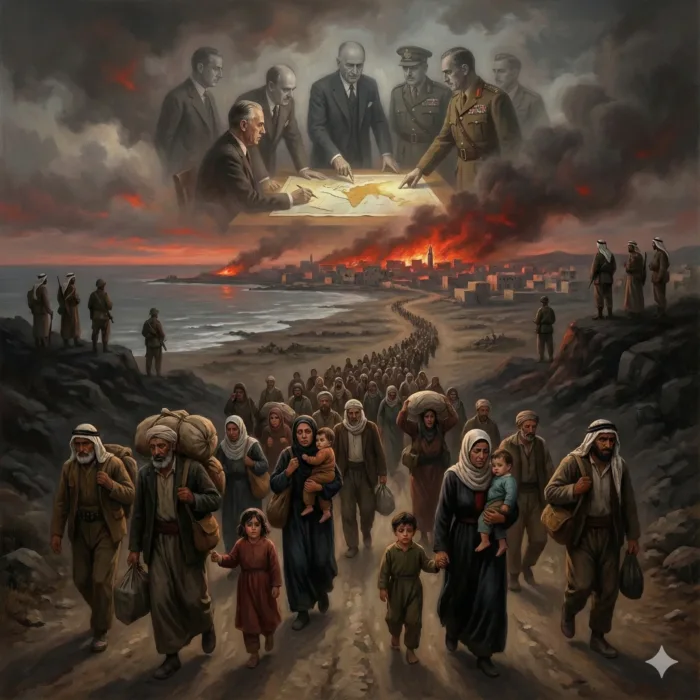
In every story of a falling city or a massacre in a village, waves of fleeing people and refugees flowed out. They came from the cities that fell, the villages that were demolished, the places where massacres occurred, or the villages for whom these massacres and falls were a warning, fleeing before they faced the same fate because there was no longer any means or possibility to confront these armies.
Therefore, it can be said that these miserable waves of humanity wandered aimlessly. They went to the West Bank, Gaza, Lebanon, or Syria—to any place or village depending on the roads open to them. Sometimes they wandered in the wilderness not knowing where to head. On the road, many died from weakness, illness, hunger, or cold. Sometimes they died from scorpion or snake bites. The lucky ones among them were those who could take shelter in a cave, a grotto, or under a rock. As for the rest, they were exposed to the cold, hunger, and diseases.
On May 14, 1948, the High Commissioner of the British left Palestine. At that moment, Ben-Gurion arrived and declared the independence of the State of Israel. Behind him stood a large portrait of the founding theorist, Theodor Herzl, the man who planted the first seed and died eight years later. Herzl’s entire time in the Zionist movement was eight years, yet his dream was realized forty years after his death (from 1904 to 1948)—forty-four years in total.
With this, another promise was also fulfilled—the ancient Quranic promise of the gathering of the Jews once again in the Holy Land, as in the Almighty’s saying: {And WE said after him [i.e., Pharaoh] to the Children of Israel, “Dwell in the land, and when there comes the promise [i.e., appointment] of the Hereafter, WE will bring you forth in [one] gathering.”}3(Al-Isra: 17 – 104).
From here, a new phase began in the history of Palestine, the Arabs, and the Muslims, and indeed in the history of the entire world. We will begin to address this phase, ALLAH willing, in the next article.
We ask ALLAH, the Blessed and Exalted, to teach us what benefits us, to benefit us with what HE has taught us, and to increase us in knowledge. Peace, Mercy, and Blessings of ALLAH be upon you.
Sources:
- Mohamed Elhamy. قصة فلسطين | 11. الصدمة الهائلة.. إعلان إنشاء دولة إسرائيل!!. Telegram Video.
- The Summary of the Palestine Story ↩︎
- Saheeh International translation ↩︎
- Saheeh International translation ↩︎