Table of Contents
The Meccan Era and the Quest for Authority
When Umar ibn Al-Khattab and the Companions unanimously chose the migration to Medina as the starting point of the Islamic calendar, they did so for a profound reason. It was definitely not merely because the Prophet Muhammad (Peace be upon Him) had masterfully planned a discreet exit at noon, hired an expert guide, and arranged a covert intelligence network. While these logistical details are remarkable, the Prophet (Peace be upon Him) exhibited brilliant strategic planning in many other situations throughout his life. The true Significance of the Hijrah lies in the fact that it marked a definitive, paradigm-shifting turning point: the actual birth of the Islamic state.
Consequently, the entire Meccan period must be viewed as more than just a phase of spiritual nurturing and individual character building. In reality, it was a relentless quest to establish an independent sovereign state. If we trace the major milestones of the Prophet’s journey during this era, this political objective becomes undeniable. He initially focused His message on the tribal leaders of Mecca. When they stubbornly refused, and the protective cover of His uncle Abu Talib disappeared due to his passing, leaving the Prophet (Peace be upon Him) vulnerable to a hostile system, He immediately turned to Ta’if—the competing center of power in the Arabian Peninsula—specifically targeting its elite chieftains.
Seeking Protection and Sovereignty
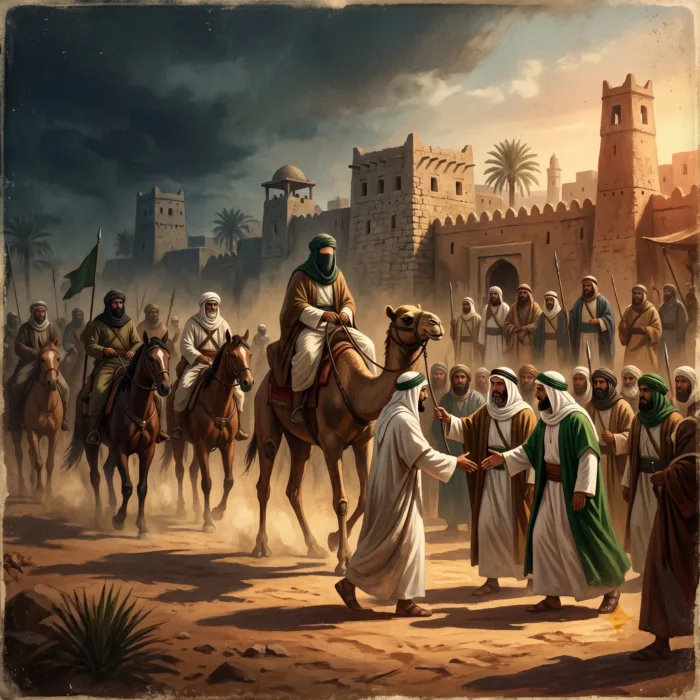
The Prophet’s strategy consistently revolved around securing sovereign protection to establish Islam’s political presence. He presented Himself to various tribes, specifically negotiating with their leaders to secure asylum and the necessary authority to build a state among them. When a small group from Medina finally responded to His call, He dispatched His ambassador, Mus’ab ibn Umair, to cultivate this new base. However, the ultimate success that reassured the Prophet (Peace be upon Him) only materialized when the paramount leaders of Medina, such as Sa’d ibn Mu’adh, Usaid ibn Hudair, and As’ad ibn Zurarah, embraced the faith, effectively transferring the city’s political allegiance to Islam.
This pursuit of sovereignty explains why the Islamic movement was always either functioning under strategic protection or actively seeking it, culminating in the mass migration once a secure base was established. The Prophet (Peace be upon Him) had previously instructed new converts from outside tribes to remain with their people. Yet, the migration to Medina became an absolute religious obligation for all Muslims, despite the severe environmental hardships and the overwhelming economic and social burdens this sudden population influx placed on the city. The overarching goal was to consolidate power, as fundamental societal problems can only be resolved when a community possesses true authority and statehood, driven by sincerity and resolve.
Why Authority Matters in Islam
If the Prophet’s ultimate goal was simply to form a spiritual study circle or disseminate a philosophical idea, He could have easily remained in Mecca. He could have patiently hoped to gradually increase His followers over decades or centuries until they formed a majority, consoling Himself with the thought that “decades are but a moment in the lifespan of a nation“, or that He would merely plant the seed for future generations to harvest.
Alternatively, when He visited Ta’if, He could have simply requested a quiet tent on its outskirts to slowly attract individuals. But He deliberately went straight to its highest political authorities. Similarly, if His mission lacked political dimensions, the tribal leaders wouldn’t have recognized the heavy political cost of His message, which they aptly described as “a matter that kings despise.”
Upon arriving in Medina, the Prophet (Peace be upon Him) did not simply operate under the secular banner of AbduLLAH ibn Ubayy ibn Salul, the agreed-upon local leader at the time. He did not ask for mere freedom of speech and religious expression. From the moment He entered the city, the Prophet assumed the role of its supreme leader and sovereign authority.
Aisha (may ALLAH be pleased with Her) insightfully noted that the political vacuum left by the mutual destruction of Medina’s old guard during the Battle of Bu’ath paved the way for this transition, as the surviving youth were far more receptive to revolutionary change. It was only within this newly established political framework that the comprehensive legal rulings of Sharia were revealed, demonstrating that the full application of Islam is inherently tied to the existence of a sovereign state.
Correcting Modern Misconceptions
Understanding this historical reality shatters several pervasive misconceptions held by many today. First, it exposes the critical flaw in believing that mere preaching, educational outreach, and moral reformation are the sole methods for societal revival, while entirely neglecting the pursuit of political authority. It also refutes the naive strategy of dismantling organized Islamic entities to simply blend into the broader society, hoping that disorganized acts of charity and general awareness will somehow miraculously lead to systemic advancement. The Prophet’s targeted approach toward structural leadership proves that establishing a functioning authority was always a primary, non-negotiable objective.
Furthermore, this understanding systematically dismantles the modern arguments for a “gradual” implementation of an Islamic state or the idea that national “stability” must precede the establishment of the religion. Anyone who studies the fragile, highly volatile conditions of Medina at the time of the Hijrah knows that it was rife with severe religious, political, economic, and military crises, yet the state was established regardless. It proves the futility of compromising Islamic leadership for a secular “consensus president” or delaying the implementation of Sharia under the pretext of solving economic problems first. History teaches us that divine law and sovereign authority are the very tools required to solve those societal crises, not luxuries to be postponed.
Sources:
Mohamed Elhamy. ترى لماذا اختار عمر والصحابة معه لحظة الهجرة لبدء التاريخ؟. Telegram Video.