
Table of Contents
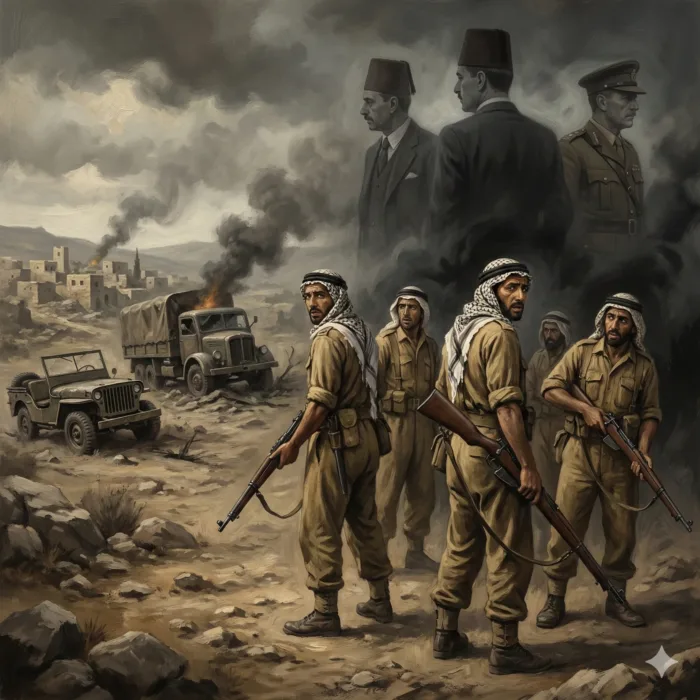
This thirteenth installment exposes the “farce of farces”: the intervention of the official Arab armies. It reveals the shocking disparity in power, intelligence, and sincerity between the Zionist forces and the Arab regimes. It uncovers how political betrayal, British command over Arab troops, and disastrous truces turned a purported rescue mission into a mechanism for handing over 78% of Palestine to the Zionist state, cementing the catastrophe of the Nakba.
In the Name of ALLAH, the Most Gracious, the Most Merciful. All Praise is due to ALLAH and Peace and Blessings be upon the Messenger of ALLAH, His family, His companions, and those who align with Him.
Welcome, beloved brothers, to a new article in the “The Story of Palestine“. This series briefly summarizes the essence of Palestine’s history, from the inception of the idea of a Jewish return to the land, up until the moment the Flood erupted in October 2023. The aim is to understand the roots of this story: Why does it remain a burning, inflamed issue? How did Herzl succeed where his ancestors failed for 3,000 years? And what is the future of this story as mentioned in the Quran and Sunnah, and as indicated by current events?
For those who wish to verify the information, these articles are extracted from the book “Summary of the Story of Palestine“1. The download link is available, allowing one to trace every piece of information to its source accurately.
In the previous article, the story of the Nakba was addressed, and the discussion regarding the Palestinian resistance to the Nakba was divided into three sections:
- The First Section: Discussed the Holy Jihad organization led by Abd al-Qadir al-Husseini.
- The Second Section: Covered the Volunteer Army (Salvation Army) organized by the Arab League, and the farces of this army were mentioned in the previous article.
- The Third Section: Concerns the official Arab armies that entered Palestine.
It was stated at the end of the previous article that despite all the farces and mockeries that occurred, the Palestinians, along with the volunteers and the few other Arab volunteers—who were in tragic circumstances—managed to maintain control of 82% of the land until the moment the Arab armies entered following the British withdrawal. Now, let us examine the “farce of farces”: the farce of the Arab armies.
The Decision to Intervene and the Shocking Imbalance of Power
To begin, it was mentioned that Britain forbade the Arab armies from entering Palestine before the date of the British withdrawal (May 14, 1948). The armies adhered to this date, even though the English withdrew from many important cities before this deadline, allowing the Jews to seize them. Therefore, the Holy Jihad forces and the Salvation Army forces were in harsh conditions because there was a Jewish army—strong, trained, mobile gangs—while there were no Arab armies present.
It must also be said that the Arab states did not decide to send their armies until May 12, 1948, merely two days before the British withdrawal. In truth, there was no real intention to intervene at all, since the decision was made on the twelfth of May. One can imagine: What could two days accomplish regarding mobilization and war planning?
Some contemporaries of this period attribute the secret to the impulsive rush of king AbduLLAH (King of Jordan)—as it was mentioned that king AbduLLAH announced he would fight to defend the Arabism of Palestine. Naturally, AbduLLAH’s army was British-trained, his army commander was English, and he himself was one of the most loyal agents of the English. This stance is what entangled the others, as they wanted to flee the accusation of treason. However, it cannot be said that this was the only reason; in reality, the British arrangement was above all these regimes.
Initially, attention must be drawn to something of utmost importance: the total number of the combined Arab armies amounted to only one-third of the Zionist forces, and this was true throughout all stages. This year (the year of the 1948) witnessed three jumps in troop numbers, but the numerical balance (the ratio) did not change. In May, they were thirty-five thousand; in September, sixty-five thousand; and in December, seventy-six thousand. The only army that increased its numbers during the war was the Egyptian army, which started with ten thousand and ended with forty-five thousand.
Beyond this disparity in numbers, there was also a disparity in armament and training, which was certainly in favor of the Zionist army. The Zionist forces had English training and armament, along with experience in battles, the latest being World War II. As for the Arab armies, they lacked training and armament; ultimately, they were considered fledgling armies, subject to foreign hegemony, belonging to states enjoying only formal, not genuine, independence.
Now, there is a difference in numbers and a difference in experience. There was also a massive difference in intelligence. The Zionist gangs lived on the land, trained on it, and had intelligence apparatuses operating for thirty years. An intelligence apparatus working on the ground and amidst the population, having built settlements and laid plans to seize villages.
However, the Arab armies did not have the slightest information about the situation. A man like Mahmoud al-Sabbagh—who was the commander of the Egyptian volunteer forces from the Muslim Brotherhood—mentioned in his memoirs that when he requested maps of the land in Palestine from the Egyptian army command, they brought him maps from thirty years prior (meaning, before the British occupation). This information was worthless because the conditions of the land had changed: settlements had been built, roads constructed, and Jewish facilities established. Therefore, the volunteers were forced to gather information from scratch.
So, there was a disparity in numbers, a disparity in experience, and a disparity in information. Above all this, the Arab armies had neither the political, financial, nor military support received by the Zionist forces, who were backed by the superpower. They were supported politically in international organizations, supported even within Arab royal palaces, and supported financially with an open line across the Mediterranean, with funds flowing from donations in Europe and America, alongside an open military line. Therefore, these armies were in a difficult situation.
Add to this that these armies lacked any degree of trust, coordination, or sense of a unified battle. The contemporary American historian Eugene Rogan said:
“Had the intervention of the Arab armies possessed a slight amount of coordination and pre-planning, and a touch of trust and sense of common purpose, the Arab forces might have been able to achieve victory. However, the Arabs entered Palestine fighting each other more than they fought the Jewish state“
This is the statement of the American historian Eugene Rogan.
A Theater of the Absurd: Internal Flaws and Political Betrayal
This dispersion led to strange matters that are almost unbelievable. For example, as Major General Mahmoud Shit Khattab reports, the Iraqi army was fighting in a mountainous area while possessing armored vehicles; since the area was mountainous, the armor was useless in this environment. Meanwhile, the Egyptian army was fighting in open areas and did not have armor. The Iraqi army had 25-pounder cannons but no ammunition, while the Egyptian army had ammunition for these cannons but did not have the cannons! Arab forces arrived in Jordan without ammunition because they relied on the assumption that ammunition existed in Jordan, only to be told in Jordan: “We have no ammunition”.
These factors and dangerous disparities were sufficient to overturn the balance of any battle. Even if an army filled with enthusiasm, sincerity, and bravery were placed in such circumstances, it would naturally lose the war, and lose it disastrously. How then, when these armies also contained other internal calamities and disasters?
Truly, this 1948 War was one of the tragic, wondrous wars that can be described by the saying: “The worst calamity is that which makes one laugh“. Take the matters mentioned regarding disparities (numbers, experience, information, lack of plans, weapons), and add to them other circumstances:
- The Arab armies were subordinate to a Supreme Command. Who was the Supreme Command of the Arab armies? The Jordanian Army. Yet, the king of Jordan had originally agreed to the partition resolution! Imagine the battle against the partition resolution being led by a commander who agreed with the partition resolution! His goal was to annex the land partitioned for the Arabs to his kingdom; his goal was not to refute or destroy the partition decision.
- The Supreme Command of the armies belonged to a man consenting to the partition, and this Jordanian Army (which was the Supreme Command) was led by English officers, headed by “Glubb Pasha”, the commander of the Jordanian Army. Thus, the command of the Arab armies entering Palestine to liberate it was under the leadership of an English officer who had close relations with the Zionists.
- Take a third matter: The largest bloc of these armies (the armies of Egypt, Iraq, and Jordan) had English weaponry and ammunition. Britain was the one who formed these armies during the occupation periods. The weapons and ammunition these armies possessed, and what reached them, was with British knowledge (English weapons) and according to British calculations. Britain originally wanted to establish Israel; thus, it knew and guaranteed that these weapons would not pose a threat or danger to the Zionists.
- The Arab armies adhered to political decisions—decisions coming from politicians. These politicians were originally subservient to the British occupier. In their movements, they advanced if orders came, and withdrew if orders to withdraw came, without the advance having field plans, nor the withdrawal being according to combat necessities. Furthermore, if the scales tipped in favor of these armies, the Security Council intervened and imposed a ceasefire. The Arab governments and armies adhered to it, allowing the Zionists to catch their breath and return after the truce with greater numbers and equipment, while the Arab armies stood paralyzed, increasing neither in number nor equipment, committed to the truce.
- A fifth paradox: Many divisions of these armies treated the inhabitants of Palestine as a threat to them, rather than treating them as a popular incubator. These armies often entered villages and collected weapons from them (naturally under the pretext and excuse that they would handle the defense of the village, and that weapons must be unified, and it was inappropriate for weapons to remain behind the Arab armies). Then, they would withdraw before the Zionist armies, leaving the village defenseless. Consequently, the village was forced to flee for fear of a Zionist massacre.
- A sixth matter: It was mentioned previously that the resistance in Palestine preferred that official armies not enter the conflict, and that Arab states suffice with securing funds and weapons for the people of the land because they knew their country best. It was even mentioned that this should not involve the entry of Arab armies because it would be global propaganda leading to sympathy for the Zionists and bringing them more financial support, as a “small state under attack by large states”. Here also, the attack of these armies, from a theoretical legal standpoint, was considered a violation of UN resolutions or a challenge to international law. There is a beautiful phrase by Ahmed Hussein (the Egyptian national leader) saying: “UN resolutions are ink on paper, but when they are in favor of the great powers, they become an enforceable judgment“.
The Course of the War: Truces, Retreats, and Lost Opportunities
One can imagine: How do you expect a war to unfold between two sides in this manner? King AbduLLAH was originally known as an ally of the Zionists. Menachem Begin in his memoirs quotes Ben-Gurion describing king AbduLLAH as “the wise ruler”. Before the outbreak of the war, there were secret meetings between king AbduLLAH and Zionist leaders. Incidentally, these meetings were mentioned by AbduLLAH al-Tal in his memoirs, mentioned by one of king AbduLLAH’s guards who was close to him, published by Israel in its official book (Israel has a book called The War of 1948: The Official Israeli Narrative), and mentioned by Golda Meir in her memoirs.
In this meeting with Golda Meir—of course, Golda Meir at that time was still a leading figure, not yet Prime Minister—king AbduLLAH promised that he would not fight the Israelis. When she wanted to inquire further, he got angry and told her: “This is a promise from a Hashemite Bedouin king given to a woman; I cannot break it”. This is what Golda Meir wrote in her memoirs.
The entire Jordanian participation in the 1948 War was arranged in a secret meeting that brought together the Jordanian Prime Minister (named Tawfiq Abu al-Huda), the commander of the Jordanian Army Glubb Pasha, and the British Foreign Secretary Bevin. Glubb Pasha spoke about this meeting in his memoirs.
Even another surprise: AbduLLAH, king of Jordan, did not only aspire to annex the part allocated to the Arabs. He thought of a betrayal no one else thought of, not even the English and French; he communicated with the Christians of Lebanon on the basis that they establish a Christian state for themselves, in exchange for him annexing the Muslim-majority parts to himself. This was mentioned by Taha al-Hashimi in his memoirs. Taha al-Hashimi’s memoirs are important because they were diaries; he was writing his daily logs. Imagine how this could be the Supreme Command of the armies?
Another matter: The plan for the Arab armies to enter Palestine was drawn up in Amman, then scrapped and redrawn, then scrapped again to return to the original. Details can be found, for example, in a book like Challenge and Response by Awni Farsakh. This scrapping, returning, and modification happened after the armies had moved! Consequently, efforts were scattered, and doubts and obsessions were raised. Ultimately, these armies entered separately, without a coherent plan. Thus, these military divisions became easy prey for Zionist gangs.
Glubb Pasha (commander of the Jordanian forces) refrained from entering Jerusalem and gave the Zionists a five-day opportunity to control and decide the battle. These five days are known in history as “The Red Five Days in Jerusalem”. For this reason, the Jews seized West Jerusalem. The partition resolution designated a part for Jews, a part for Palestinians, and an international part (between Jerusalem and Jaffa). With this, the partition resolution was torn apart, and the Jews seized West Jerusalem, leading to the displacement of sixty thousand Palestinians.
Truly, the Jordanian Army’s fighting against the Zionists was not an attempt to liberate what they occupied of the land, but rather an implementation of the partition resolution; he seized areas of the West Bank to annex them to his kingdom. He was executing the plan to establish Israel as decided by international powers, and as agreed upon by king AbduLLAH with the Zionists and the English in these secret meetings.
Therefore, the Jordanian Army sometimes handed over positions directly to the Zionist army. This was narrated even by the martyr AbduLLAH Azzam, may ALLAH have mercy on him. It must be said that the Jordanian Army (including the English officers) did oppose the Jewish attempt to control Old Jerusalem and Al-Aqsa Mosque because Britain at that time feared that if Al-Aqsa Mosque fell, it would incite Muslims all over the world, including Muslims in India and other lands.
The Iraqi Army remained for five days after the British withdrawal without entering Palestine, present in its locations, stopped in its locations, frozen in its locations in Jordan, moving very slowly. Until the moment of the first truce, only one brigade entered Palestine, spreading over a long line. Consequently, it was a weak, disjointed deployment; attacks caught up with it, and it was struck with severe blows. Also, the instructions of its commanders were the same as the instructions of the English commanders in the Jordanian Army.
The Egyptian Army entered from the south. It did not receive orders to advance directly toward Jerusalem. Indeed, the Zionist forces cleared the way for it and did not intercept it. When it approached Jerusalem, forces from the settlements it had left behind pounced on it. This is the simplest military ambush that even a small child would not fall into. Consequently, the army was scattered, its divisions besieged, its movement paralyzed, and afterward, orders came for it to withdraw. It withdrew in a difficult manner via a long detour.
Details are mentioned, for example, in the book The Muslim Brotherhood in the Palestine War by Kamel al-Sharif (who was an eyewitness) and other sources. Consequently, these armies withdrew, leaving behind a shameful memory even among the Palestinians. It is very famous, for example, that whenever people sought help from the Iraqi Army, they would say: “Maku awamir, maku awamir” (meaning: “There are no orders, there are no orders” to move and aid or rescue you).
It must be said and emphasized that some divisions in these armies, and some factions, executed many heroic acts and created excellent battles. However, these were the ones who rebelled against political decisions—this is an important point—or were forced by field circumstances to fight in isolation from these high orders. The heroisms were neither political heroisms nor the heroisms of regimes; they were the heroisms of those who disobeyed the regimes in the field or were isolated from them.
Truthfully, it is regrettable that everything these Mujahideen managed to achieve in these battles went to waste at the hands of Arab regimes that issued withdrawal orders, modifications to the plan, or adhered to a ceasefire and truce. Some of them imprisoned the Mujahideen of the Palestine War, arrested them, and persecuted them—the most famous incident, of course, being the case of the Muslim Brotherhood in Egypt. Likewise, some Iraqi commanders who did not respond to withdrawal orders were put on trial. Thus, these heroisms were lost at the hands of these regimes.
There were three stages of fighting separated by two truce periods. In summary, the first stage of fighting was the best for the Arabs and the worst for the Israelis. Despite all that was previously mentioned, when these armies entered and some of their factions fought (those mentioned as having rebelled), and when the Palestinian situation and the volunteer situation revived with the entry of the armies, the Israelis were confused. They needed to distribute themselves over a number of fronts to fight simultaneously. Nothing saved them except the UN decision to implement a truce for 28 days, accompanied by a decision to ban armament in this region.
The Bitter Harvest: The Nakba and the Partition of the Remnants
The Arab rulers adhered to this truce, while the Israelis seized the opportunity, increasing the number of fighters and stocking up on weapons (violating the UN resolution). When the first truce ended, the Zionists regained the initiative. When they resumed fighting, they seized the northern regions. The Zionist forces managed to defeat the Syrian and Lebanese armies, and even received the cities of Lydda and Ramla from the Jordanian Army without the slightest defense, without even an attempt to defend. Afterward, they devoted themselves to focusing on the Egyptian front in the south.
The United Nations gave them another truce, a new truce. The first truce was a month (28 days); this truce was three months (from July to October). Israel also exploited it to stock up on weapons and men, after which it completed the defeat of the Egyptian forces. Here, borders were drawn between the forces through ceasefire agreements. At this moment, Israel became a reality on the ground. The Egyptian authority began confiscating the weapons that volunteers were collecting and the equipment they found, in order to cut off the path for the resistance to continue (now there is a political decision to stop the war; they even stopped the volunteers).
Consequently, truthfully, when Palestine fell, the share of agents in its fall was no less than the share of the Zionists or the share of the occupiers. Sheikh AbduLLAH Azzam has a very beautiful phrase:
“The Jews received in a period of five months multiples of what they seized over fifty years“
Because the people of Palestine—focus on this—the people of Palestine remained, until the moment the Arab armies entered, owning approximately 93% of the land (approximately, based on the details of what they lost and what they could have retrieved). Practically, when the Arab armies entered, the Palestinians had ownership of 93% of the land. When the Arab armies withdrew, the Jews had seized 78% of the land.
Imagine! The partition resolution gave them 55%; the Arab armies gave them an additional 22%, so they ended up with 78% of the land. This is a strange scene and seems astonishing.
This was recorded by Bahjat Abu Gharbieh and recorded by Khalil al-Wazir (who would be one of the founders of Fatah) in his memoirs. He says:
“The corridors of the Arab League did not witness any Arab meeting regarding Palestine at that stage without the British General Clayton being a supervisor and director of the meeting and its decisions. Thus, he was able to extract Arab cover for his colonial conspiracies in Palestine“
The Arab intervention and the Arab League’s intervention (whether by the Volunteer Army, the official armies, or the conspiracy against the Palestinians) was the Arab cover for executing the conspiracy.
Therefore, if you look at the map of 1948 and see how the areas allocated in the partition resolution to the Arab states or Arabs in Palestine receded, they receded due to Israeli victories over the Arab armies that entered. The final result of the Nakba was as follows: The destruction of 531 Palestinian villages and cities. Israel thereby seized approximately 78% of the land. It is as if the Arab armies were fighting in the ranks of the Israelis and supporting the Zionist project!
Above that, the tragedy of the refugees occurred. Naturally, 58% of the population of Palestine was displaced (more than 805,000 Palestinians). Leaving the villages was the only solution, the available solution for a defenseless, exhausted people stripped of weapons before armed and criminal Zionist gangs.
At that time, the general perception among the Palestinian people (which helped in the magnitude of this migration and displacement) was that the Arabs would never remain silent about this, and that as soon as the Arab armies entered and expelled the Zionist gangs, people would return to their homes. Their departure at that time was not a form of negligence or surrender, but a decision driven by two factors: first, weakness and inability before heavily armed gangs; and second, hope in the promise the Arabs made to themselves.
It is noted that half of the refugee tragedy (half of the refugees) had been expelled from their villages before the entry of the Arab armies. The refugee tragedy was not a tragedy of war as the Zionists promote (claiming “we did not displace these refugees, they left their homes because of the war”). Half of the refugees left as a result of massacres, Zionist invasion, and English complicity (this was before May 14, 1948). The others are those who fled under the conditions we narrated regarding the presence of the Arab armies, the hope they held, the Arab armies stripping them of weapons, and the subsequent defeat of the Arab armies.
Therefore, these refugees were distributed in three directions: the Gaza Strip, the West Bank, and outside Palestine in surrounding countries (Jordan, Syria, and Lebanon). Consequently, regarding the areas remaining of Palestine: Gaza equals one and three-tenths percent (1.3%) of the area of Palestine, and the West Bank equals twenty-one and a half percent (21.5%) of the area of Palestine. These two remaining areas were raced for by two states (Egypt and Jordan) to be annexed, and were not left to the Palestinians. Egypt annexed the Gaza Strip, and Jordan annexed the West Bank.
It was mentioned that Jordan abandoned the cities of Lydda and Ramla, and Egypt abandoned parts of the Gaza Strip (one can refer to a study by Dr. Salman Abu Sitta—one of the most important Palestinian historians who focused on the issue of land—titled How the Borders of Gaza Were Formed). The Egyptian regime abandoned parts of the Gaza Strip that the Israelis did not obtain by fighting, but were conceded by the Egyptian negotiator. Naturally, they conceded the village of “Umm al-Rashrash”, now known as “Eilat”, to be an outlet for Israel on the Red Sea.
The annexation of the West Bank to Jordan was not denounced by the general Palestinian populace. Yes, indeed, they hated being under AbduLLAH’s authority, but some saw this annexation as a form of protection, so the Palestinian body would not remain without a guardian, just as happened after World War I when Ottoman protection vanished (recall that the first Jerusalem Conference of Palestinian leaders called for annexing Palestine to Syria as part of Greater Syria).
Consequently, the annexation of the West Bank to Jordan took place, or was legitimized by a series of conferences held in the West Bank (King AbduLLAH arranged most of them). What matters is that the idea of annexation itself was not denounced or rejected, but those who feared this annexation and did not welcome it were afraid of king AbduLLAH’s policy because he was a loyal man of the English. The Palestinians were not against Arab and Islamic unity, but they were against AbduLLAH specifically.
How does the story of Palestine continue? This is what we will see, ALLAH willing, in the next article.
We ask ALLAH, the Blessed and Exalted, to teach us what benefits us, to benefit us with what HE has taught us, and to increase us in knowledge. Peace, mercy, and blessings of ALLAH be upon you.
Sources:
Mohamed Elhamy. قصة فلسطين | 13. مؤامرة الجيوش العربية لتثبيت إسرائيل وتضييع فلسطين. Telegram Video.

Informative article