
Table of Contents
This eighteenth installment explores the pivotal shift toward independent Palestinian action following the initial decades of displacement and regional dependency. Having previously examined the geopolitical maneuvers of Arab states and the normalization between Egypt and Israel, this article shifts focus to the internal dynamics of the Palestinian Resistance. It exposes the motivations behind the formation of the Fatah movement, the ideological struggles within Islamic circles, and the transition from theoretical discourse to active engagement on the ground. This chapter highlights how the vacuum left by state military failures was filled by grassroots mobilization and the eventual dominance of Yasser Arafat’s leadership in the national struggle for self-determination.
In the Name of ALLAH, the Most Gracious, the Most Merciful. All Praise is due to ALLAH and Peace and Blessings be upon the Messenger of ALLAH, His family, His companions, and those who align with Him.
Welcome to a new article in the “The Story of Palestine“, a series that briefly recounts the history of Palestine from the inception of the idea of a Jewish return up to the outbreak of the Flood in October 2023. The objective is to understand the roots of this enduring conflict, examining why it remains an inflamed issue today, how Theodor Herzl succeeded where his predecessors failed for three thousand years, and what the future holds according to the Quran, the Sunnah, and unfolding events.
For those wishing to verify the information presented, these articles are extracted from my book “Summary of the Story of Palestine“1; and a download link is available for referencing the original sources.
The Resilience of the Palestinian Cause and Historical Precedents
History provides numerous examples of dominant powers successfully eradicating or fully absorbing the indigenous populations they conquered. The indigenous peoples of Australia and the Americas serve as somber reminders of how populations can be decimated or forced to dissolve into the occupier’s civilization until they effectively disappear. Similar patterns of erasure occurred during the forced conversions and expulsions of Muslims in Al-Andalus and across parts of Eastern Europe, where those who remained were often assimilated into the culture of the superior military force.
When an enemy possesses an overwhelming disparity in power and its objective is settler-colonialism—seeking displacement and replacement rather than mere exploitation—the total suppression of resistance and a final resolution in favor of the occupier often becomes a historical reality.
However, the situation in Palestine possesses a unique characteristic that has prevented such a conclusion: the presence of Jerusalem and the Al-Aqsa Mosque. As a sanctified site mentioned in the Quran and a fundamental component of the Islamic creed, Al-Aqsa represents a spiritual anchor that cannot be uprooted from the hearts of the global Muslim community. This deep-seated religious significance provided the Palestinian resistance with a profound foundation, allowing it to endure under extreme conditions that might otherwise have led to total subjugation or annihilation. The struggle against Zionist expansion has always relied on this “solid pillar”, which served as a source of resilience during the most difficult periods of the conflict.
Throughout various phases of this struggle, the banner of Palestinian resistance has been carried by both Islamic and non-Islamic factions. While secular or nationalist groups dominated the political landscape during certain eras, the underlying Islamic depth of the cause ensured that the movement would eventually gravitate back toward Islamic frameworks when other ideologies faltered or diminished. Some of these competing movements eventually retreated from their original principles or even began serving the interests of the occupation. Consequently, the Islamic dimension remained a constant support system for the Palestinian resistance, even during periods when non-Islamic movements were the most prominent or when they deviated from the path of liberation.
Six Pillars Driving the Emergence of Independent Resistance
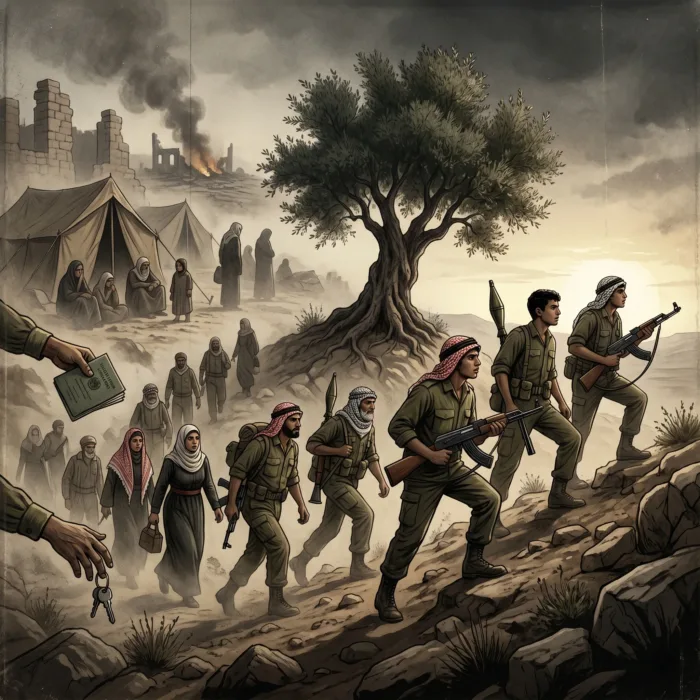
Following the 1948 Nakba, the Palestinian resistance initially manifested as a small, fragmented line of volunteers, a trend that largely stalled after the 1956 Suez Crisis. During this early phase, Islamic activists, particularly from the Muslim Brotherhood, were notable participants, with figures like Kamil al-Sharif leading efforts involving volunteers from Gaza and Sinai. While these were promising beginnings, the experience was largely stifled by regional Arab regimes that suppressed grassroots movements in the West Bank and Gaza for various political reasons. As the “Era of Resistance” began to take a more distinct shape, several critical factors converged to convince Palestinians of the necessity of forming a resistance movement independent of Arab state control.
The foremost reason for this shift was a profound sense of despair regarding the neighboring Arab regimes. It became increasingly clear that these states would not take decisive action toward the liberation of Palestine; even after Israel attacked Egypt in 1956, no tangible steps were taken toward reclaiming Palestinian land. This lack of state-led initiative forced the Palestinian people to look inward. Simultaneously, the success of the Algerian Revolution served as a powerful inspiration. Algeria’s ability to achieve independence from France through its own efforts, without waiting for the realization of “Arab Unity”—a prerequisite often cited by nationalists at the time—demonstrated that a determined population could secure its freedom independently.
Thirdly, the failure of legal and diplomatic avenues became undeniable. Figures like Ahmed al-Shukeiri, a legal expert who served on numerous international committees, documented how legal attempts through the United Nations and the Security Council consistently resulted in a vacuum of results. This failure, combined with the Algerian model, reinforced the belief that “Armed Struggle” was the only viable means to unite the people and force the Palestinian cause onto the international agenda. Furthermore, there was a desperate need to transition from rhetoric to action. Decades of speeches and slogans had accumulated without changing the reality on the ground, leading to a pervasive demand for a functional movement that prioritized mobilization over oratory.
The Genesis of Fatah and the Role of Islamic Youth
A fifth critical factor was the realization that Arab states would not only refuse to resist but would actively prevent Palestinians from doing so. Consequently, anyone wishing to join the Palestinian resistance had to operate in total secrecy, building “underground” organizations while navigating the immense social and economic pressures of life in the diaspora. Finally, the traditional Palestinian leadership, represented by Hajj Amin al-Husseini, had been neutralized and rendered ineffective by the pressure of regional governments. These six factors—despair, inspiration, diplomatic failure, the need for action, state suppression, and the collapse of old leadership—paved the way for the emergence of the Fatah movement.
The story of Fatah begins with Yasser Arafat, who was a prominent figure among Palestinian students in Egypt. Arafat was closely associated with Islamic circles and led the Palestinian Students’ Union, a body where Islamic-leaning students typically held sway until the movement was suppressed in Egypt in 1957. Another key founder, Khalil al-Wazir (Abu Jihad), had been a member of the Muslim Brotherhood’s youth wing in Gaza and was active in early resistance operations. After being imprisoned and eventually exiled by the Egyptian authorities, he traveled through Saudi Arabia to Kuwait, where he reunited with Arafat to lay the groundwork for a new movement.
Examining the founders of Fatah reveals a striking detail: nearly all were originally products of Islamic movements. Figures such as Salim al-Zanoun, As’ad Saftawi, Muhammad Yusuf al-Najjar, Kamal Adwan, and Rafiq al-Natsheh all shared this background. Until roughly 1963, Fatah continued to recruit from the Muslim Brotherhood while simultaneously opening its doors to other ideological currents. This raises a vital historical question: if the leadership and the core membership were predominantly from Islamic backgrounds, why did Fatah evolve into a secular movement? Furthermore, why did organized Islamic factions disappear from the front lines of the Palestinian resistance until the late 1980s?
Ideological Divergence and the Absence of Organized Islamic Action
The absence of a formal Islamic resistance during this period was largely due to the crushing blows dealt to Islamic movements in Egypt and the Levant. In Egypt, the movement faced devastating crackdowns in 1954 and 1965, the latter culminating in the execution of Sayyid Qutb in 1966. In Syria, laws were enacted that made membership in the Muslim Brotherhood a capital offense, leading to decades of persecution. While Jordan took a different approach—focusing on containment and absorption rather than violent suppression—the Islamic activists there were often refugees who did not have the luxury of rebelling against their host state or initiating independent military actions against Israel.
In the midst of this general weakness, many within the Islamic movements adopted a defensive ideological stance to reconcile their lack of participation in the active Palestinian resistance. They embraced the theory that the liberation of Palestine was a task beyond the current capabilities of its people, who were seen as too weak to face the combined might of Zionism and its international allies. According to this view, the priority was the establishment of an Islamic State, which would then possess the resources and legitimacy to carry out the burden of war and liberation. This shifted the focus of their work toward da’wah (proselytization), education, and social preparation, effectively postponing military engagement.
This theoretical framework “formalized” the Islamic movement’s exit from the immediate battlefield. They went as far as taking disciplinary actions against members who insisted on joining the armed struggle, often dismissing them from their ranks to distance the organization from the nascent resistance groups. For these leaders, the trauma of previous defeats and the fear of further persecution led them to a policy of caution and internal preparation. However, this choice caused a significant internal rift; many young members refused to wait, leading them to break away and join nationalist or leftist factions to pursue the Palestinian resistance more actively.
The Nationalist Paradigm Versus Independent Action
It must be emphasized that the ideological justification for delaying armed conflict was not exclusive to Islamic movements. The majority of political parties formed in the post-Nakba period were grounded in Pan-Arab nationalism, and they too believed that Palestinians were incapable of achieving liberation on their own. For these groups, Palestine was fundamentally an “Arab nationalist cause” rather than a localized national issue. Consequently, Palestinians integrated into various Pan-Arab parties across different countries with the primary goal of establishing a unified Arab state. It was believed that only this unified, monumental entity would possess the capacity to wage the war for liberation. Therefore, a consensus existed between both Islamists and Nationalists that unilateral Palestinian action was insufficient.
However, a critical distinction must be drawn regarding the circumstances surrounding these two factions. While the Islamic movements were being ruthlessly dismantled and crushed during this era—particularly in Egypt and Syria—the Pan-Arab nationalists were experiencing their golden age, enjoying peak political power and influence across Egypt, Syria, and Iraq. While the severe persecution and sheer lack of capability might offer a historical explanation for the Islamists’ absence from the battlefield, no such excuse exists for the Pan-Arab regimes, which failed to mobilize their immense resources for the Palestinian resistance during the height of their prosperity.
Ultimately, the burden of initiating the struggle fell neither to the organized Islamists nor the dominant state-backed Nationalists, but rather to the independent Palestinian patriots. These individuals embraced the conviction that Palestinians must spearhead the battle alone, acting as the vanguard that would eventually compel the broader Islamic and Arab nations to join the fight. Heavily influenced by the successful Algerian model of self-emancipation, this period marked the vital formation and consolidation of a distinct, independent Palestinian national identity, setting the stage for a new phase of armed struggle.
The Proliferation of Factions and Regional Maneuvering
This newly forged independent path brought both strategic advantages and severe complications. The Fatah movement attempted to wrestle the Palestinian cause away from the suffocating grip of competing Arab regimes, striving for maximum decision-making autonomy despite the grueling circumstances. Fatah had to carefully balance its independent actions, effectively snatching its authority from the jaws of wealthy, powerful, and deeply divided Arab states, each of which sought to monopolize the Palestinian resistance for its own geopolitical leverage. Conversely, these Arab regimes constantly manipulated the situation, sometimes co-opting the cause under the banner of “Arabism,” and at other times discarding their responsibilities by labeling it a strictly “Palestinian problem.”
To operationalize its goals, Fatah established its military wing, named “Al-Asifah” (The Storm). Founded in 1957, Al-Asifah launched its first official military operations in December 1964. Over the next year and a half, leading up to 1967, the group executed approximately two hundred operations. As time progressed, Fatah’s secular, nationalist identity became so deeply entrenched that any external observer analyzing the movement would find it almost impossible to discern its original Islamic roots.
Fatah, however, was not the only organization operating in this space. The “Arab Nationalist Movement” emerged among students at the American University of Beirut, initially adopting Pan-Arab ideology and supporting Nasserist policies before concluding that resistance should not wait for the elusive dream of Arab unity. Led by prominent figures like George Habash, this group eventually embraced Marxist thought. Additionally, the Palestine Liberation Front emerged under the leadership of Ahmed Jibril. By 1967, these distinct groups, alongside several smaller factions, unified to form the Popular Front for the Liberation of Palestine (PFLP), adding profound ideological diversity to the Palestinian resistance.
Gamal Abdel Nasser and the Creation of the PLO
This surge of independent, underground militant activity aroused both anxiety and political appetite in Egyptian President Gamal Abdel Nasser. Years earlier, Nasser had personally dismantled the All-Palestine Government led by Amin al-Husseini, systematically restricting the leader and his government until the entity completely dissolved. Yet, sensing the shifting tides and the rise of uncontrollable factions, Nasser abruptly revived the concept of a Palestinian political entity. Dusting off an ignored 1959 Arab League resolution, he spearheaded the creation of the Palestine Liberation Organization (PLO) in 1964, handpicking a man named Ahmad al-Shukeiri to serve as its chairman.
At the time, al-Shukeiri was a highly prominent Palestinian figure with a stellar diplomatic record, having served for fifteen years at the United Nations as the representative for Syria, and subsequently for Saudi Arabia. In that era, the rigid bounds of modern citizenship were more fluid, and it was entirely normal for ministers, royal entourages, and diplomats to serve nations other than their own, a lingering reflection of the regional unity from the Ottoman era. Following a diplomatic fallout with Saudi Arabia—triggered by his refusal to file complaints against Nasser at the UN—al-Shukeiri was dismissed by the Saudis, inadvertently making him the perfect candidate for Nasser’s new strategy to contain the Palestinian resistance.
From the perspective of the Egyptian regime, al-Shukeiri possessed the exact profile required: he was a brilliant legal mind, a gifted orator, and a seasoned diplomat, but crucially, he lacked the grassroots organizational charisma needed to build an independent power base. Furthermore, his recent conflict with Saudi Arabia aligned perfectly with Nasser’s own regional rivalries. This calculated appointment allowed Nasser to exert significant control over the trajectory of the Palestinian resistance through the newly established PLO framework. It is worth noting that al-Shukeiri’s beautifully penned memoirs, spanning two thousand pages and published by the Center for Arab Unity Studies, remain an exceptionally rich and elegant historical resource regarding this era.
The Golden Era of Armed Struggle and the Battle of Karameh
The foundational Palestinian National Council convened in Jerusalem in May 1964, bringing together approximately four hundred and one representatives of the Palestinian people. The council officially elected al-Shukeiri as the chairman of the PLO, affirmed the commitment to liberating all of Palestine, and decreed the establishment of the Palestine Liberation Army (PLA).
While the general Palestinian public rejoiced at the prospect of an Egyptian-backed political entity and a formal military force, the underground movements actively engaged in the Palestinian resistance remained deeply skeptical. Fatah and the leftist factions refused to join, viewing the PLO as a superficial Arab maneuver to monopolize Palestinian affairs without possessing a genuine will to fight. Historical figures like Amin al-Husseini, who had firsthand experience with Nasser’s suppression, shared this profound distrust.
When the catastrophic defeat of 1967 occurred, it inadvertently yielded a tactical advantage: it became possible to establish bases for the Palestinian resistance in frontline states governed by weakened regimes, namely Lebanon and Jordan. The resistance was historically unable to operate within the borders of powerful Arab states. This highlights a recurring historical pattern in the region: highly centralized, powerful regimes rarely utilize their strength for the benefit of the populace, frequently employing it to crush internal dissent while capitulating to external enemies. Conversely, when these regimes weaken, the resulting power vacuum often operates in favor of the masses and against the interests of the occupation.
The years from 1967 to 1970 are widely considered the “Golden Era” of the Palestinian resistance, particularly within Jordan. Following the stunning loss of the West Bank, the Jordanian monarchy was severely weakened and forced to release Palestinian detainees. Unable to suppress the influx of fighters, the state had no choice but to tolerate the establishment of resistance outposts along the length of the Jordan River.
The absolute pinnacle of this era was the Battle of Karameh, which took place on March 21, 1968. During this pivotal confrontation, elements of the Palestinian resistance alongside Jordanian military forces successfully repelled a major Israeli military incursion, inflicting heavy casualties—over thirty dead and a hundred wounded—and forcing the invading troops to retreat. This battle provided the region with its first precious taste of victory, shattering the post-1967 mythology that the Israeli military was an invincible force.
Interestingly, this joint defense occurred despite the historically strong ties between the Jordanian regime and Israel. The engagement was made possible by a sympathetic Jordanian field commander, Mashhour Haditha al-Jazy, who independently initiated combat against the Israeli forces without awaiting orders from the high command. Historical testimonies from figures across the political spectrum, as well as the commander’s own subsequent accounts, confirm that this crucial intervention was a spontaneous act of solidarity with the Palestinian resistance.
In the aftermath of the Battle of Karameh, Fatah’s prestige skyrocketed, dominating the Palestinian landscape from the diaspora to the refugee camps in Gaza. Tens of thousands of eager volunteers flooded into their ranks. The pressure on Islamic leadership became so immense that many Islamist youths broke away to join the fight, leading to the formation of “Sheikh Camps” in Jordan. These camps comprised Islamic fighters operating under the operational umbrella of Fatah, to the extent that Fatah would issue the official martyrdom statements for fallen Islamic combatants.
This massive influx of manpower and financial support caused a dramatic surge in military activity. Operations executed by the Palestinian resistance escalated from roughly 12 per month in 1967 to 52 per month in 1968, soaring to 199 per month in 1969, and peaking at 279 per month by early 1970. Capitalizing on this undeniable momentum, Fatah integrated into the PLO and swiftly assumed control as its largest faction. By February 1969, Yasser Arafat was named the chairman of the PLO, marking a massive political victory where leadership was earned through armed struggle rather than granted by the patronage of Arab regimes.
However, this triumph brought monumental challenges. Arafat was no longer just the leader of Fatah; he was now responsible for the entire umbrella organization representing the Palestinian resistance. The PLO contained numerous factions that were heavily infiltrated or directly sponsored by foreign intelligence services from Syria, Iraq, Egypt, and beyond. Arafat could neither fully control these rival groups, force them to adhere to Fatah’s directives, nor expel them without shattering the fragile unity required for the struggle. The dangerous interplay between this hard-won political legitimacy and the structural chaos of infiltrated factions ultimately steered the movement toward a severe disaster, setting the stage for the catastrophic events to be discussed in the next historical chapter.
This achievement intertwined with an immense challenge. The dangerous interplay between this hard-won political legitimacy and the structural chaos of infiltrated factions ultimately steered the movement toward a severe disaster. This looming catastrophe will serve as the starting point for the next historical chapter, ALLAH willing.
We ask ALLAH, the Blessed and Exalted, to teach us what benefits us, to benefit us with what HE has taught us, and to increase us in knowledge. Peace, Mercy, and Blessings of ALLAH be upon you.
Sources:
Mohamed Elhamy. قصة فلسطين | 18. عصر الكفاح الفلسطيني.. نشأة غريبة لحركة فتح!. Telegram Video.
