Table of Contents
This fourteenth installment explores the critical period “Between the Nakbas” (1948–1967). It delves into how the Zionist state consolidated its power and achieved international recognition, while the Palestinian people faced the harsh reality of dispersion and the brutal suppression of their resistance by neighboring Arab regimes. It sets the stage for understanding the profound political and social shifts that led to the second catastrophe in 1967.
In the Name of ALLAH, the Most Gracious, the Most Merciful. All Praise is due to ALLAH and Peace and Blessings be upon the Messenger of ALLAH, His family, His companions, and those who align with Him.
Welcome, beloved brothers, to a new article in the “The Story of Palestine“. In this series, we attempt to summarize the essence of Palestine’s history, from the inception of the idea of a Jewish return to the land, up until the moment the Flood erupted in October 2023. We try to understand this story: Why does it remain inflamed and burning? How did Herzl succeed in establishing the state his ancestors failed to create for 3,000 years? What do current events say, and what is the future of this cause in the Quran and Sunnah?
The Nakba ended, Israel was established, and the Arabs surrendered to it. How did the chapters of this bitter story continue? Three files must be opened. This period can be called “Between the Nakbas”, meaning between the Nakba of 1948 and the Nakba of 1967. The discussion will cover three matters:
- Conditions within Israel.
- Conditions in Palestine (How were the conditions in Palestine between the Nakbas?).
- Conditions of the Arab countries surrounding Palestine in the period between the Nakbas.
The Consolidation of the Zionist Occupation and the 1956 War
In Israel, the Jewish Agency, which was the executor of the state-creation project, did not hesitate or cease its work. The Zionist state was recognized by international powers as soon as it was announced: America and Russia were the first to recognize it. America and Russia were the two global superpowers at that time; this signified the recognition of the world, or the primary powers in the world, of Israel. Later, naturally, the European powers followed suit.
The first thing Ben-Gurion sought and established was making Jerusalem the capital; that is, Jerusalem would be the capital of the State of Israel. This was contrary to the desire of international powers, including the Americans. The allies of the Zionists—including the Americans—were against declaring or dealing with Jerusalem as the capital of the state of Israel. As mentioned previously, Jerusalem was an international zone in the partition resolution, and the issue of Jerusalem is a provocative and sensitive one. However, Ben-Gurion executed his decision and moved the headquarters of the government and ministries to Jerusalem, disregarding the international stance.
Only the Ministry of Foreign Affairs remained in Tel Aviv because the embassies and diplomatic missions remained there, as countries did not recognize this step taken by Ben-Gurion. Thus, Tel Aviv remained the official capital, but Jerusalem became the actual capital of Israel from its early days, housing the government headquarters from which the country was managed. Ministers went to Jerusalem in haste; even Golda Meir mentions in her memoirs that she lived for a period in a room on the roof of a house until a home befitting a minister was prepared (she was a minister in Ben-Gurion’s government at the time).
Regarding the political environment—specifically on the external level—Israel sought to stabilize its footing and entrench its existence, ensuring this presence was a concrete reality and not merely a fragile one. Therefore, since that time, the security obsession began to be the primary controller. Because this state was established on the displacement of many inhabitants (the owners of the land), it had to exert its maximum energy in frightening and terrorizing these inhabitants against any attempt to reclaim their land or even sneak back into it, as this land had become within the borders of Israel.
It was mentioned that most of the refugees had originally left hoping to return, seeing it as imminent, and trusting in the ability of the Arab army to defeat the Zionist gangs; thus, they did not surrender to the idea that their land was lost. Consequently, Israel began with a security obsession, specifically the obsession with controlling the land and possessing enough force to terrorize those thinking of returning to their homes and lands.
Therefore, Israel launched a number of attacks on the West Bank, Gaza, Syria, and Jordan, killing many civilians and even elements of the army and police belonging to these governments. Furthermore, those who sneaked in and tried to return or take something from their homes and belongings were killed upon capture, their bodies mutilated and hung to serve as a lesson to others.
Within these attacks, it can be said that the most dangerous and extensive aggression committed by Israel was the broad attack in 1956 on Sinai within Egyptian territory. At this moment, Israel began a war within an Anglo-French plan so that this war would be a pretext for the intervention of the English and French when Abdel Nasser announced the nationalization of the Suez Canal Company. Israel was relied upon (of course, England and France did not want to start the war themselves as this contradicted the American sponsorship of Abdel Nasser at that time), so they wanted Israel to ignite a battle to serve as a pretext.
Israel at that time could have been exposed to danger had the Egyptian army been vigilant. However, in reality, Israel relied on the negligence and corruption present within the Egyptians and Abdel Nasser’s regime. Consequently, it hastened to occupy Sinai, and subsequently, English and French forces hastened to occupy the Suez Canal. The Egyptian army received a severe blow in this war.
However, this aggression—known as the Tripartite Aggression and sometimes called the Suez War in some sources—occurred against the desire of the Americans and also against the desire of the Soviets. It revived the presence of “Old Colonialism” (English and French colonialism), while these regions had effectively been inherited by the Americans. Thus, America stood against this Tripartite Aggression and threw its weight to force England, France, and Israel to evacuate. Yet, Israel was the most significant winner of this war because it extracted a number of important gains for itself.
What are these gains extracted by Israel that concern the story of Palestine?
- First: Israel proved its capability for a surprise and successful attack on Egypt. Egypt is the largest Arab country, and its army is the strongest Arab army. This was the first test for the July Revolution’s military regime; the July Revolution and its military regime originally claimed to have revolted for several reasons, including the cause of Palestine. It now turned out to be a helpless regime from which Sinai itself could be occupied. This is the first gain: proof of capability and superiority.
- Second: Israel extracted for itself the right to freedom of navigation in the Gulf of Aqaba. If one looks at the map, the Gulf of Aqaba connects Israel to the southern half of the globe (from the Gulf of Aqaba to the Red Sea, to the Gulf of Aden, to the Indian Ocean, to the entire Eastern region). It is true that Israel controlled the head of the Gulf of Aqaba in 1948 and the Egyptians conceded the village of “Umm Al-Rashrash” (Eilat) to it, but anyone looking at this gulf will see that it ends at two islands: “Tiran and Sanafir”. These two islands effectively close this gulf; if forces are present there, no Israeli ship can pass. These two islands are within Egyptian territory. In this war, Israel stipulated, in exchange for its withdrawal, that it enjoy freedom of navigation in the Gulf of Aqaba, meaning Egyptian forces would no longer interfere with it. This is the second gain, and the Egyptians did not know of this gain until later, around 1967; Egyptians did not imagine that Israel was sailing in their waters without objection.
- Third and Important: International forces were deployed on the Egyptian-Israeli border. What does this mean? It means that the Egyptians would not be able to surprise Israel with any military action. If the Egyptians thought of attacking, they would have to inform these forces (international forces) or ask them to leave. Consequently, it was no longer possible for Egyptian forces to risk attacking Israel, nor, of course, attacking international forces.
Israel almost succeeded in making the Gaza Strip a separate sector under international supervision. However, the situation in Gaza—demonstrations, protests, and the adherence of the people of Gaza to being under Egyptian administration (these were demonstrations led by Gazan Islamists to keep Egyptian sovereignty over the Gaza Strip)—prevented that.
In this manner, it can be said that Israel entrenched its power through the 1956 war, solidified its influence in the region, increased its importance and presence, and even expressed its expansionist dreams, showing it was not content with what it took in 1948 but would proceed to take more. Also, the ease with which it managed to seize Sinai tempted it later to repeat the matter in 1967.
There was another dangerous expansion implemented by Israel in the period between the Nakbas: its infiltration of Arab regimes with direct agents loyal to it in sensitive positions. Among the most important of these was “Eli Cohen”; Eli Cohen reached the position of Deputy President of Syria. It was proven that he was spying for the Israelis and was executed; he was discovered by fate and executed.
Another was “Ashraf Marwan”; Ashraf Marwan was the son-in-law of Abdel Nasser, his private secretary for information, and the husband of his daughter. He was also one of the most important agents belonging to Israel. Both men (of course there are others, but the discussion is now about very sensitive and dangerous positions) played dangerous and decisive roles in transferring important information to the Israelis, whether during the second Nakba in 1967 or in the October War of 1973. This was the Israeli situation in brief.
The Erosion of Islamic Identity and the Rise of Nationalisms
Entering the situation of Palestine: It was mentioned that throughout the era of British occupation, a clear Palestinian identity formed for the society in Palestine. It was noted that there was a weakness in the collective attachment to Islamic identity and the Islamic bond. This stems from several matters, including a general apathy that afflicted Islamic identity across the entire Islamic world after the collapse of the Islamic Caliphate and after most Islamic countries fell under foreign occupation (and those not under direct occupation were under indirect foreign influence) and the dominance of secularism.
Secularism pervaded this Islamic world, and within this secular idea were two schools: a leftist socialist communist school (belonging to the Eastern camp led by the Soviet Union) and a Western capitalist liberal school (leaning toward the Western camp led by America).
Regarding the weakness of Islamic identity and the prominence of national identity, there are two reasons:
- The weakness of the Islamic condition due to the collapse of the Caliphate.
- The dominance of secularism.
One can add the strengthening of the national concept because this entire Islamic region was divided into modern states. Each state adopted a flag, a constitution, and a law, began to have institutions, and started forming its national personality (individual, independent personality). Each state began digging and searching in history to form a separate, independent national history, no longer considering itself part of the Islamic world or Islamic history. Thus, there became an Egyptian history, a Syrian history, a Jordanian history, a Saudi history, and so on.
These three matters—the absence of the Islamic Caliphate, the dominance of secularism, and the reinforcement of nationalism (all under the influence of foreign hegemony)—reinforced each other, leading to the prominence of the Palestinian national identity.
It must be emphasized that this general weakness in attachment to the Islamic bond does not mean that the Palestinian inclination was a national inclination stripped of Arab identity or hostile to Islamic identity. No; the people of Palestine continued to view the liberation of their land as a general Arab duty and believed that when Arabs fought in Palestine, they were performing their duty (Arabs were not doing a favor, were not bestowing charity, and were not merely “friends” or “allies” doing this).
This Arab identity, formed and prevailing at that time, was also reinforced by certain matters, most importantly that it is an identity based on a solid, established reality: the inhabitants of Palestine extended into the surrounding societies. A single family existed in Palestine, Jordan, Egypt, Syria, and Lebanon. Sometimes, a landowner in Palestine lived in Lebanon or Syria while his properties were in Palestine. There was no meaning to national separation or clear real borders (neither geographic nor demographic borders); these lands were all one land.
Even if one overlooks that Palestine is a holy Islamic cause and a cause for which hearts burn, many Arab volunteer fighters came to defend their people, their wealth, and their honor. Their own families were present there, and they had extended tribes.
Naturally, saying “the Arabs came” is influenced by the pressure of the dominant culture and the national meaning prevailing now. In that era, no one viewed them as “coming from outside” or viewed the locals as “the people of the country” in a separate sense. They did not see themselves as Arabs distinct from Palestinians, for example, nor did the people of Palestine see those arriving as guests. These terms are used now only to address people in this era; therefore, neither we nor they can escape the influence and power of the dominant ideas governing reality.
Secondly, the Arab states (specifically those surrounding Palestine) effectively intervened politically and militarily in the cause. They took the slogan of Arabism as a shield, stating that this was their duty compelling them to intervene to liberate Palestine and fight Zionism. In fact, they proceeded on this path to the extent that they prevented the people of Palestine from defending themselves. They constricted them, as discussed previously, because the raised slogan was that the cause of Palestine is a general cause, not a private one; a cause of armies, not gangs; a cause of Arabism, not a cause of homelands.
This discourse, spoken by Arab leaders, media, and intellectuals, found a great resonance in the exhausted, violated Palestinian society that had been weakened over decades. Consequently, the discourse of Arabism—the discourse of wishes—became entrenched in the soul of the weak, oppressed, and helpless.
After the Nakba, this Arabist discourse reached its peak. Arab Nationalism (secular nationalism) rose to the zenith of its power with the rise of the Nasserist tide in Egypt and the rise of the Ba’ath Party in Syria and Iraq. This Arab discourse focused on the unity of the Arab nation, the liberation of Palestine, and the expulsion of the Zionist gangs. The war of Palestine was present in the first communiqué of the Egyptian military coup.
Egypt at that time was the sole media power in the Arab world through radio and the press. This nationalist discourse inspired overwhelming euphoria and gave great hope to the people of Palestine and others. Thus, the meaning of Arab national belonging became entrenched among Palestinians, while the Islamic meaning weakened (not in the sense of detachment, but in the sense of weakness).
Arab Regimes: Guardians of the Zionist Borders
It is true that there was an Arabist affiliation and an Arabist discourse, but did this have an echo on the ground? Unfortunately, far from the rhetoric and slogans, the facts of reality were something different. On the contrary, Arab regimes intervened in this cause in a way that made it a political card in their hands, or a means of their presence and influence.
The past era witnessed the English preventing Palestinians from forming a unified Palestinian leadership because they wanted to pave the way for the Jewish state. The Arab era witnessed this same role (preventing Palestinians from forming a Palestinian leadership) but at the hands of Arab regimes. Once the English did it, and once the Arabs did it.
After the Nakba, the “Arab Higher Committee” (led by Haj Amin al-Husseini) tried to form a government in Palestine to fill the political vacuum (as there was a British withdrawal and land not yet occupied by Israel). It exerted effort before the Nakba to transform into a government, but the Arab governments rejected this. The most averse, most rejecting, and most distant from this was King AbduLLAH, King of Jordan, because he had a lust for expanding his kingdom. Consequently, the establishment of a Palestinian government would prevent the expansion of his kingdom. For thirty years, he had remained regretful that he was granted this barren piece of land called Jordan, despite being the eldest son of Sharif Hussein.
When the Nakba occurred and the Arab armies were defeated, the Arab Higher Committee announced the “All-Palestine Government”. Indeed, Arab states recognized it, except for Jordan. This committee called for a meeting of a legislative council in Gaza, headed by Haj Amin al-Husseini, to confirm the government’s legitimacy. However, immediately—mere hours later—the Egyptian government sent a military force that took Haj Amin al-Husseini, members of the government, and some council members, and forcibly transferred them to Cairo, taking control of the Gaza Strip itself.
Consequently, the Palestinian government became a formal government, a government in exile, a government without powers, without the ability to practice anything. Surveillance was tightened on Amin al-Husseini in Egypt, and the headquarters of the Arab Higher Committee was besieged. Thus, the Prime Minister of Palestine no longer had importance; they gave him a title: “Delegate of Palestine to the Arab League”. In reality, the Arab states practically empowered Israel and helped stabilize and entrench its swallowing of this country, even more than what the partition resolution had allocated to it.
Above this, the two important Arab regimes (Egypt and Jordan) controlling Gaza and the West Bank exerted great effort in thwarting any resistance operations or infiltration across the borders (parenthetically: Israeli borders). Security agencies worked to penetrate any Fedayeen (freedom fighter) formations, even though Israel committed constant aggressions and violations of ceasefire lines.
There is a published report by the Arab League (a report by the Arab League office at the UN); this report, while monitoring truce violations, also monitors the official Arab effort in combating infiltration and pursuing Mujahideen, and how they were punished with imprisonment, fines, exile, beatings, torture, and more. This is aside from what the media of these regimes later did in distorting and vilifying the resistance. In reality and fact, the Arab regimes performed their role from the first moment in protecting Israel and chasing those who wanted to resist Israel.
Under this situation, it would be foolish to ask: Were the Arab regimes thinking of moving their armies or responding militarily to Israeli raids and violations, or even thinking of liberating Palestine? Fundamentally, the Arab regimes handed Palestine over to the Zionists.
This was not merely corruption or an unintended mistake; the track record of Arab governments with Palestine was a track record of complete treason. The states that were said to be independent and liberated from colonialism did not differ in behavior from the states said to remain under foreign occupation. Supposedly, after 1952, after countries gained independence, policy should have changed (specifically regarding Palestine), but it did not happen; the same behavior before the occupation was the same behavior after the occupation.
The Social Earthquake and the Birth of Fatah
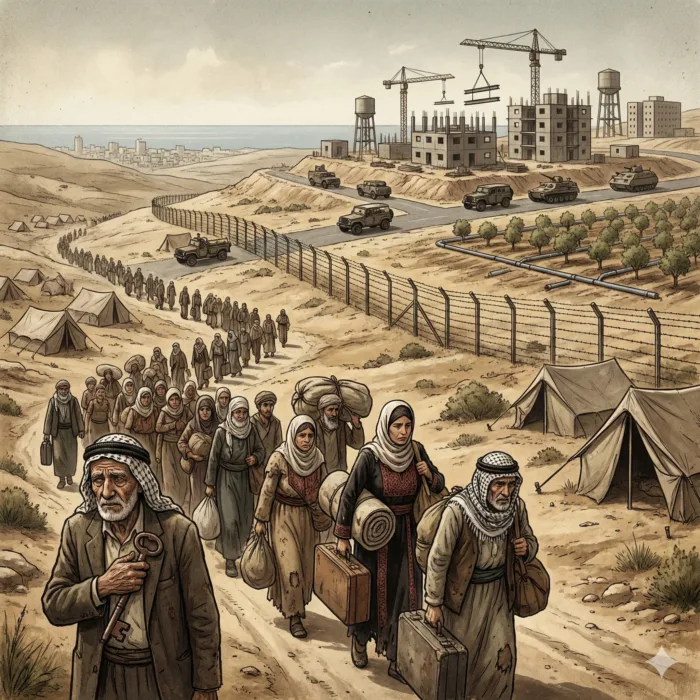
Also crucial to what the Palestinian people were subjected to while tracking their condition between the Nakbas is this violent earthquake: a political earthquake, an economic earthquake, a social earthquake. The Nakba and the resulting flow of migration changed the face of the entire Palestinian society. It was mentioned that the society continued to be exhausted and drained during the British occupation; now, the society was shocked, torn, and scattered. It might even be asked: Do these people deserve the description of a “society” or not? Because they were subjected to a huge disaster. This disaster of refuge led to the formation of new social classes and segments in the camps and the cities around them.
First, many migrated to the confrontation states (neighboring countries), and many others migrated to the Arab Gulf states. Of course, the Arab Gulf states at that time were witnessing an oil boom and were beginning to build themselves and their institutions. They found in the Palestinians a workforce capable of building (teachers, doctors, experts, and workers). Likewise, Palestinians found in the Gulf an opportunity and hope for escaping poverty.
The Palestinian ultimately was a competent working element in all fields. The Palestinians themselves paid immense attention to education because education in the society of refugee society—or the society of those struck by catastrophe and living in camps or under occupation—became the sole path toward social mobility. The land was lost, the country was lost; no properties, no agriculture, no trade. Therefore, Palestinians became the most educated among Arab peoples, and many obtained excellent academic degrees from Arab, European, and American universities. The earthquake that occurred in Palestinian society was a political earthquake accompanied by a social and economic earthquake.
This sweeping socio-economic earthquake, combined with Arab politics (specifically Egyptian and Jordanian politics), contributed to influencing the Palestinian resistance, whether political or military.
- Politically: The Arab Higher Committee began to wither and fade, and the star of Haj Amin al-Husseini began to dim as he was like a hostage in Cairo, unable to leave, until he broke away to Lebanon in 1958.
- Militarily: In the beginning, there were small operations carried out by individuals or limited groups trying to breach the borders to hunt some soldiers. However (relative to their capabilities), they could not do anything major. It can be said that within seven years, they caused 1,200 Israeli deaths (from 1949 to 1956). But it stopped because, after 1956, the Nasserist regime became very strict in guarding the borders and no longer allowed any attacks against Israel.
Mr. Galal Kishk says about the situation in Gaza (and how the Egyptian authority ruled Gaza):
“The bloody, treacherous record of what these agencies committed against the youth of Gaza whenever they tried to organize resistance to liberate their country has not yet been chronicled. Nor how this youth remained in Abdel Nasser’s prisons and detention centers until the 1956 war, when these files were handed over to the Israeli occupation forces”.
In the shadow of this total despair and this vacuum, a group of young Palestinians began—in the following year, 1957—to form a new movement; this was the “Fatah Movement”. Fatah was founded in Kuwait (Kuwait had a large Palestinian population at the time, as Palestinian migration to the Gulf increased). This movement would need nine years (from 1957 to 1965) to begin its first military operation (starting in December 1964 or January 1965). This movement would start with an Islamic beginning because it relied in its essence and cadre on the youth of the Muslim Brotherhood, but it would end up being a secular movement (for reasons and circumstances to be discussed later, ALLAH willing).
It must be admitted that one of the most significant flaws of these articles is that many topics cannot be fully covered. One of the most important topics that cannot be discussed fully is the issue of Palestinian refugees. The issue of refugees is one of the bitter tragedies associated with Palestinian society. A single family was torn apart, scattered, and separated between several countries, sometimes between continents. Each individual ended up according to the circumstances available to them, their level of education, their talent, and the opportunities that came their way.
These refugees found in every Arab country varieties, forms, and types of humiliation, degradation, exclusion, and injustice. They were treated lower than other foreigners, lower even than other aliens. There was not a single Arab state that worked seriously to benefit from the energies of Palestinians on the basis of full equality with the people of the country (that the Palestinian be like the local). It did not exist; treatment varied between bad and worse.
This is a very severe tragedy (the tragedy of Palestinian refugees) because it affects all of life: travel, education, healthcare. The identity card and passport became papers affecting everything in life, from children to even the burial of the dead. These were tragedies. Above that, in times of political turmoil in the countries or in times of war, these refugees were the victims. The victim is the one who pays the price: a victim with no value, with no one to ask about them, paying the price and exposed to ordeals.
I admit and apologize that these articles cannot fulfill the cause of the refugees because the discussion is summarizing the summary of history. I am forced to abbreviate, select, and choose. However, I strongly wish for everyone reading these articles to set aside time to follow, read, or watch documentaries about the tragedy of Palestinian refugees, for it improves the understanding of the entire Palestinian cause and the tragedy of this noble people.
In the next article, ALLAH willing, the discussion will continue regarding the conditions of the Arab countries between the Nakbas. The situation of Israel and the situation of Palestine between the Nakbas have been discussed. In the next article, we begin discussing the conditions of the Arab countries between the Nakbas and how we ended up at the second Nakba in 1967.
We ask ALLAH, the Blessed and Exalted, to teach us what benefits us, to benefit us with what HE has taught us, and to increase us in knowledge. Peace, Mercy, and Blessings of ALLAH be upon you.
Sources:
Mohamed Elhamy. قصة فلسطين | 14. سنوات ما بين النكبتين: إسرائيل تتوسع والنظم العربية تقهر الفلسطينيين. Telegram Video.
